Yes, you can build a house in New Hampshire in winter, and plenty of houses are finished inside during the coldest months. The hard part is the start. Concrete has to be protected from freezing until it reaches about 500 psi, which takes roughly 48 hours at 50°F (ACI 306R-16), footings can’t sit on frozen soil, and in March and April towns post their roads to keep heavy trucks off while the frost comes out. So the usual plan in the North Country is to get the foundation in and the house closed in before deep winter, then work inside with heat until spring.
Can you pour a foundation in winter in New Hampshire?
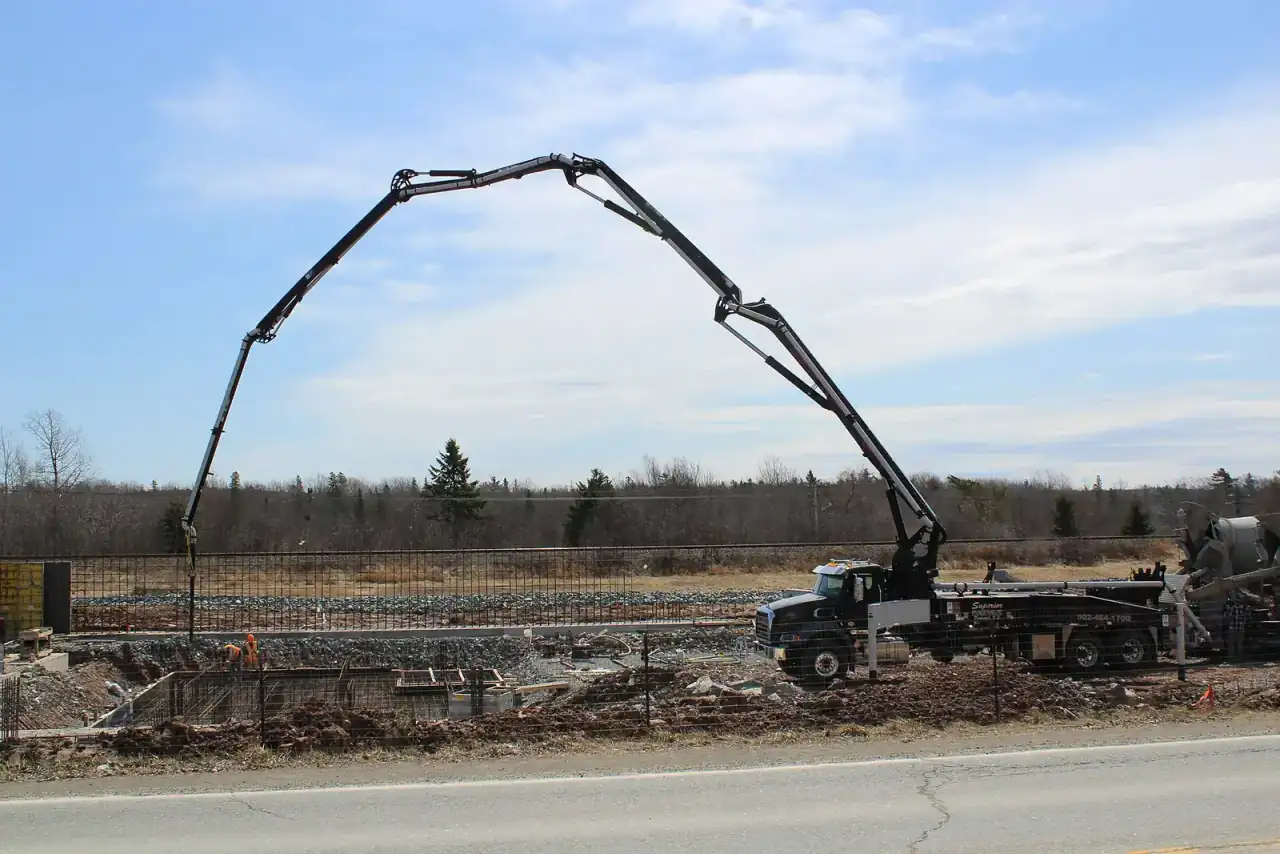
You can, with planning and money spent on protection. The American Concrete Institute defines cold weather as any time the air temperature has fallen to, or is expected to fall below, 40°F during the protection period after a pour (ACI 306R-16).
Concrete protected from freezing until it reaches at least 500 psi won’t be damaged by a single freeze and will go on to reach full strength. At 50°F, most well-proportioned mixes hit 500 psi within 48 hours (ACI 306R-16). If it freezes earlier, the ready-mix industry says potential strength can drop by more than 50% and the concrete won’t be durable (NRMCA CIP 27).
Cold also slows everything down. A 20°F drop in concrete temperature roughly doubles setting time, and hydration virtually stops at 40°F (NAHB, Cold Weather Concrete Practices).
How crews protect a winter pour
| Method | What it does | Source |
|---|---|---|
| Hot water and heated aggregate at the plant | Concrete arrives warm, sets sooner | NAHB |
| Accelerating admixture | Speeds set and early strength. Calcium chloride is capped at 2% of cement weight; non-chloride types are used where steel rebar is a concern | NRMCA CIP 27 |
| Type III (high early strength) cement or more cement | Generates more heat, reaches 500 psi faster | NRMCA CIP 27 |
| Insulated or heated blankets, straw under plastic | Hold the concrete’s own heat while it cures | NAHB; NRMCA |
| Enclosures with vented heaters | Keep air warm around walls and slabs. Unvented fossil-fuel heaters can make fresh concrete surfaces dust | NAHB |
| Clearing snow and ice, warming forms and subgrade | Concrete must not be placed against frozen surfaces | NRMCA CIP 27 |
Accelerators don’t stop concrete from freezing, so they never replace blankets and heat (NRMCA CIP 27). The NAHB bulletin also advises against pouring at all if temperatures will drop below 20°F for a significant period.
ACI’s recommended minimum concrete temperatures depend on how thick the section is. Thinner walls lose heat faster, so they need warmer concrete:
| Minimum section dimension | Minimum concrete temperature as placed and maintained |
|---|---|
| Less than 12 in. (typical foundation wall) | 55°F |
| 12 to 36 in. (typical footing) | 50°F |
| 36 to 72 in. | 45°F |
| Over 72 in. | 40°F |
Source: ACI 306.1 guidelines as reproduced by the NAHB. The wall and footing labels are typical residential sizes, not ACI’s.
What does winter concrete add to the cost?
Ready-mix suppliers charge extra for winter service. One New Hampshire example is the state’s own contract with Central NH Concrete in Henniker (2023 to 2025 term), which listed (NH DAS):
| Item | Price per cubic yard |
|---|---|
| Winter service rate, November 1 to March 31 | $10 |
| 1% non-chloride accelerator | $10 |
| 2% non-chloride accelerator | $20 |
Those are state contract prices from a contract that ended in January 2025, so treat them as an order of magnitude and ask your supplier for current numbers. For example, every 50 cubic yards poured in winter with the winter rate and a 1% accelerator adds 50 × ($10 + $10) = $1,000 to the concrete bill. Blankets, ground thawing, heaters, fuel and the extra labor to place and remove them come on top, and they usually cost more than the surcharges.
Can you dig in frozen ground?
Yes, but frozen ground is slower to dig and more expensive. A Massachusetts builder describes covering the excavation area with heated blankets or a thick layer of straw to keep frost out before digging, and notes that digging hard ground takes longer and adds cost (Green Energy Times, 2022).
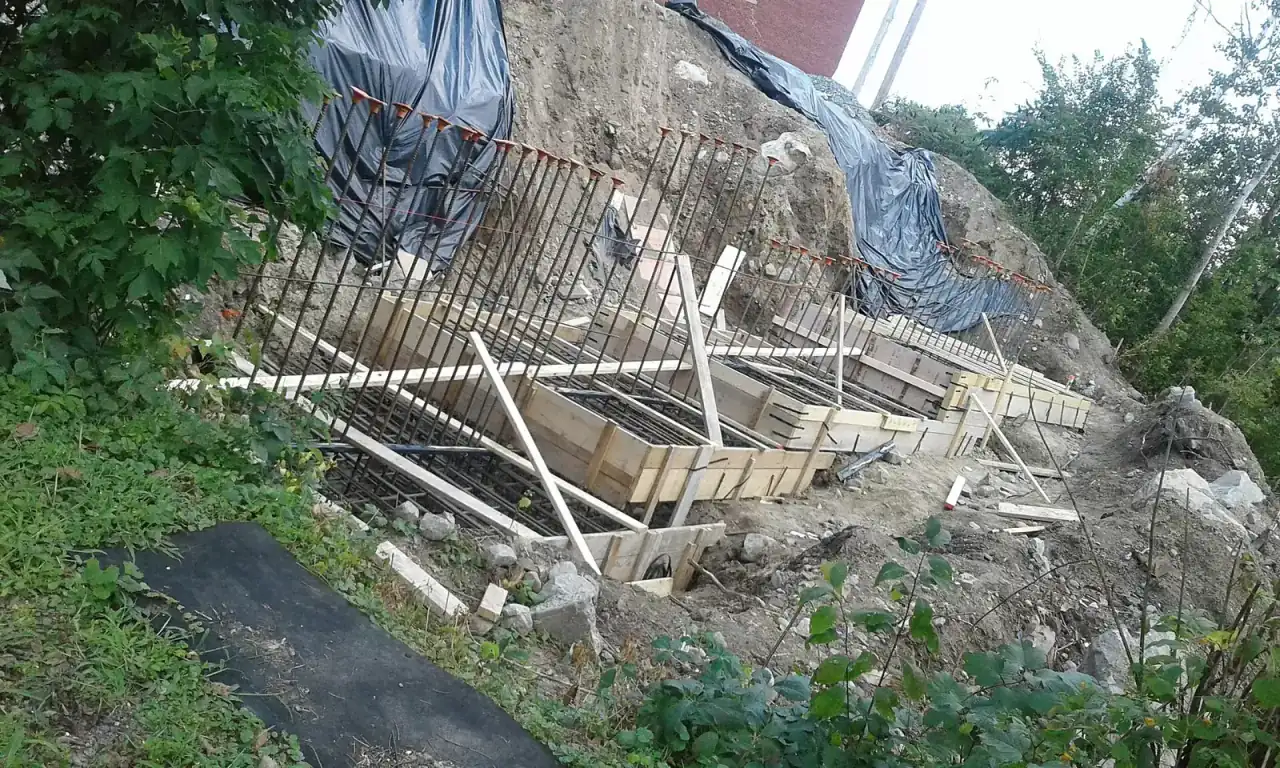
New Hampshire’s state building code adopts the International Residential Code (NH Division of Fire Safety). Under it, footings must extend below the frost line or be otherwise protected, and “footings shall not bear on frozen soil” unless the frozen condition is permanent (IRC R403.1.4.1, 2018 model text via UpCodes). Once the footing trench is open, the soil at the bottom has to be kept from freezing until the concrete is placed.
The frost line up here is deep. Bethlehem’s new single-family permit application lists a required frost level of 60 inches, along with a 105 psf snow load at 1,800 feet elevation and 100 mph wind (Town of Bethlehem). That means a lot of excavation even for a frost wall and slab, and more exposed soil to protect. We cover design frost depth and snow loads by town in our snow load and frost depth guide, and ledge and other dig surprises in site costs for septic, well and ledge.
Can you frame and dry in a house in the snow?
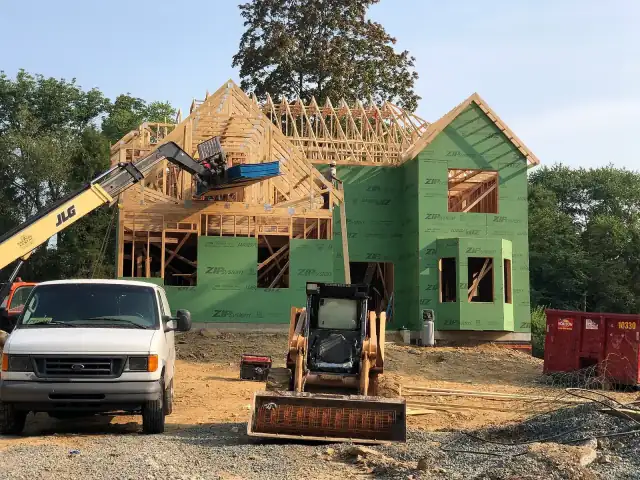
Framing goes on in cold weather. The cost is mostly time: snow has to be shoveled off decks every morning, lumber needs to be stored off the ground and covered, and icy sheathing is a slip hazard (GCD, 2026). A Vermont builder writes that a delay can leave carpenters starting every morning with snow blowers, plows and shovels, and that homeowners on a budget get frustrated with the snow-removal charges (Green Energy Times).
The goal is dry-in: roof on, windows and doors set, walls wrapped. After that, the weather matters far less. Some roofing and exterior products have minimum application temperatures, so a few exterior jobs may wait for a mild spell or for spring (GCD).
Panelized and modular shells shorten the exposed period. Unity Homes in Walpole, NH says its factory-built panels with windows and insulation already installed take about a week on site to assemble into a weathertight shell (Green Energy Times). If a winter start is non-negotiable, that’s worth weighing; see modular vs. stick-built in New Hampshire.
How do you heat a house while it’s being built?
Once the house is closed in, temporary heat keeps the work going. It’s needed for comfort and pipes, and for the finishes too.
Drywall and finishes have minimum temperatures
The Gypsum Association’s specification sets these limits (GA-216-2021):
| Task | Minimum room temperature |
|---|---|
| Hanging drywall with screws or nails | 40°F |
| Adhesive application, taping, texturing, decorating | 50°F, from 48 hours before work begins until the compound is thoroughly dry |
| Any room, with temporary heat | No more than 95°F |
The same document says extra humidity from portable gas or kerosene heaters must be removed by ventilation or dehumidification.
Direct-fired vs. indirect-fired heat
Propane salamander and torpedo heaters burn inside the house. A builder writing in Green Building Advisor estimates that every 100,000 BTU of propane burned releases about a gallon of water into the building, along with carbon monoxide risk and odors (GreenBuildingAdvisor, 2023). Indirect-fired units keep combustion outside and duct clean, dry heat in. They cost more to run but don’t soak the framing and drywall.
Using the home’s permanent heating system early is possible with some systems, but forced-air ductwork collects construction dust, which is one reason builders hold off (GreenBuildingAdvisor).
What temporary heat costs
The math on fuel, using a single 100,000 BTU/hour propane heater:
- Propane holds 91,452 BTU per gallon (EIA), so the heater burns 100,000 ÷ 91,452 ≈ 1.09 gallons an hour.
- Run around the clock: 1.09 × 24 ≈ 26 gallons a day.
- At the NH Department of Energy’s statewide average of $4.26 per gallon on November 2, 2026 (NH DOE): about $112 a day, or roughly $3,350 for 30 days.
The EIA’s weekly survey put NH residential propane at $3.90 on November 16, 2026, excluding taxes (EIA); delivered job-site prices vary. A big or poorly sealed shell needs more than one heater, while an insulated, air-sealed house can need much less. Heater rental and tank set are extra.
What are New Hampshire’s spring road postings, and how do they affect a build?
Every spring, as frost leaves the road base, NH roads lose strength and get posted against heavy loads. This is the “mud season” problem, and it can stop a job that’s ready to go.
State highways
NHDOT District Engineers decide which state road sections to post each year. On posted sections, the maximum is 30,000 lb gross weight, or the total width in inches of all tires on the road multiplied by 300, whichever is less (NHDOT). In 2026 the Commissioner ordered postings on March 9 (NHDOT press release); in 2025 the order came February 27 (NHDOT). State law (RSA 236:3-a) exempts trucks carrying heating oil, milk products and maple sap, and septic pumpers, with District Engineer approval. Concrete, lumber and excavators aren’t on that list. Posted roads are listed on New England 511 under Trucking, New Hampshire, Seasonal Posting.
Town roads
Under RSA 231:191, towns can set seasonal weight limits on class IV, V and VI roads. Driving over them overweight requires written permission from the selectmen or highway agent, who can attach conditions such as a bond, and anyone who damages a posted road can be made to restore it. Six tons is a common town limit:
| Town | 2026 posting |
|---|---|
| Lincoln | 6-ton limit posted March 13, 2026 (Town of Lincoln) |
| Moultonborough | All town roads 6 tons from March 9, 2026 (Town of Moultonborough) |
| New Boston | Town roads closed to vehicles over 6 tons from March 9, 2026, until further notice (Town of New Boston) |
There’s no fixed end date. UNH’s road-maintenance center tells towns to keep restrictions until the road base regains strength, which depends on weather, nighttime freezing, drainage and groundwater (UNH T2, March 2026).
For scale, a Seattle ready-mix supplier lists its 10-yard mixer at 72,000 lb fully loaded (SBSG). That’s more than double the state posted limit and about six times a 6-ton town limit. If your lot sits on a posted gravel road, plan on no concrete, no excavator on a lowboy and no lumber deliveries until the postings come off. A Vermont builder put it this way: their only two seasons are “foundation season” and “roads posted” season (Green Energy Times).
Your own driveway has the same problem. A new gravel drive that hasn’t been through a thaw can rut badly under a loaded truck in April.
How does winter affect the schedule and cost?
Some stages handle cold far better than others. We’d rank them like this:
| Stage | Winter sensitivity | Main added costs |
|---|---|---|
| Clearing, excavation | High | Frost removal, blankets or straw, slower digging |
| Footings and foundation | High | Winter concrete rates, accelerators, blankets, heat, possible delays below 20°F |
| Framing | Moderate | Snow removal, slower work in short days |
| Roofing, siding, exterior paint | Moderate to high | Product temperature limits, waiting for mild days or spring |
| Mechanical rough-ins | Low once closed in | Temporary heat |
| Insulation, drywall, finishes | Low once heated | Temporary heat held at 50°F or more, dehumidifying |
| Driveway paving, landscaping | Not possible in deep winter | Wait for spring |
Asphalt is a hard stop. The Massachusetts builder quoted earlier schedules a base coat of driveway asphalt and site work before asphalt plants close in mid-November (Green Energy Times).
Delays also cost money indirectly. Every month the house isn’t finished is another month of construction-loan interest and, for many owners, rent or a second mortgage. There’s no reliable published figure for the total winter premium on a NH house, and it depends entirely on which stages fall in winter. A house closed in by Thanksgiving pays for heat. A house that starts digging in January pays for almost everything on the list above.
There’s an upside that builders mention: interior trades often have more room in their schedules in winter than in the summer rush (GCD).
How long does it take to build a house in New Hampshire?
The Census Bureau doesn’t publish New Hampshire figures, but its Survey of Construction reports the Northeast region. For single-family houses completed in 2025, the share finished within each span from start of construction (US Census Bureau):
| Months from start to completion | Northeast, contractor-built | Northeast, owner-built | US, contractor-built |
|---|---|---|---|
| 3 or less | 8% | 2% | 9% |
| 4 to 6 | 17% | 13% | 25% |
| 7 to 9 | 20% | 12% | 23% |
| 10 to 12 | 16% | 26% | 17% |
| 13 or more | 38% | 47% | 26% |
“Contractor-built” means a house built for the owner by a hired contractor, which the NAHB calls the larger portion of custom home building (NAHB). The regional figures are sample estimates with wide error margins, so read them as a pattern.
The NAHB’s analysis of the same survey found that New England had the longest average time from permit to completion of any US division in 2025, at 13.5 months, against 8.8 months nationally. The average wait from permit to the start of construction was also longest in New England, at 1.8 months. Nationally, contractor-built houses took about 11.7 months from permit to completion (NAHB Eye on Housing, September 2026).
Those clocks start at the permit. Before that come design, a survey, the state septic approval and the town permit. Winter is a good time for all of those.
When is the best time to start building in New Hampshire?
For most North Country projects, work backward from two dates: when the spring road postings come off, and when the snow comes. A Vermont design-build firm writes that foundation work there waits until the frost is out, usually May (Black Mountain Design Build). The NH state concrete contract’s winter rate starts November 1. That leaves a foundation and framing window of roughly May through October.
A typical sequence we’d suggest:
| When | What |
|---|---|
| Previous fall and winter | Design and engineering, survey, septic design and state approval, town permit, builder contract, lender. If the septic designer still needs test pits, ask whether frozen ground will delay them. |
| Late spring, after postings lift | Clearing, excavation, driveway base |
| Early to mid summer | Footings, foundation, backfill, framing |
| Late summer to fall | Roof, windows, siding, rough-ins; base coat on the driveway before the asphalt plants close |
| Winter | Insulation, drywall, trim, cabinets, flooring, all under temporary or permanent heat |
| Following spring | Exterior finishes, final paving, landscaping |
If the foundation can go in during a mild November spell and the house can be closed in by Christmas, winter costs are mostly heat. If you’re facing a December or January dig on a posted road with a deep frost line, it is usually better to wait and use the time for permits and selections. The exceptions are owners with a hard deadline, or a house type, such as a panelized or modular shell, that spends very little time open to the weather.
If you’re planning a build around Littleton, Bethlehem, Franconia or Sugar Hill, Fregeau Builders can talk through timing for a custom home on your lot. Contact us over the winter and the paperwork can be done by the time the roads open.
Sources
- American Concrete Institute: ACI 306R-16, Guide to Cold Weather Concreting (preview) (accessed November 2026)
- NRMCA: CIP 27, Cold Weather Concreting (accessed November 2026)
- NAHB: Cold Weather Concrete Practices (Euclid Chemical Technical Bulletin AD-02) (accessed November 2026)
- NH Department of Administrative Services: Notice of Contract 8003201, Concrete Delivered and/or Pumped (Central NH Concrete, 2023 to 2025) (accessed November 2026)
- Green Energy Times: Building High-performance Homes Through the Winter (December 2022) (accessed November 2026)
- International Residential Code (2018), Chapter 4 Foundations, R403.1.4.1, via UpCodes (accessed November 2026)
- Town of Bethlehem: New Single-Family Construction Building Permit Application (accessed November 2026)
- GCD: Building a House in Winter in Massachusetts, Timeline Guide (November 2026) (accessed November 2026)
- Gypsum Association: GA-216-2021, Application and Finishing of Gypsum Panel Products (accessed November 2026)
- GreenBuildingAdvisor: Job Site Heaters (November 2023) (accessed November 2026)
- US Energy Information Administration: Energy units and calculators explained (accessed November 2026)
- NH Department of Energy: NH Fuel Prices (accessed November 2026)
- US Energy Information Administration: Heating Oil and Propane Update (accessed November 2026)
- NHDOT: Weight Restrictions, Spring Postings (accessed November 2026)
- NHDOT: Annual Road Postings Underway on Sections of State Highways (March 9, 2026) (accessed November 2026)
- NHDOT: Annual Road Postings Underway on Sections of State Highways (February 27, 2025) (accessed November 2026)
- NH RSA 231:191, Maximum Weight Limits (accessed November 2026)
- Town of Lincoln: 2026 Spring Road Bans, 6-Ton Limit Posted March 13, 2026 (accessed November 2026)
- Town of Moultonborough: 2026 Seasonal Weight Limit Notice (accessed November 2026)
- Town of New Boston: Public Notice, Road Weight Limit (March 9, 2026) (accessed November 2026)
- UNH Technology Transfer Center: Frost Heaves, Gravel Roads and Seasonal Weight Limits (March 2026) (accessed November 2026)
- SBSG: Truck Specifications (accessed November 2026)
- US Census Bureau: Number of Housing Units Completed by Number of Months from Start, 2025 (accessed November 2026)
- NAHB Eye on Housing: Single-Family Home Construction Time Declines in 2025 (September 8, 2026) (accessed November 2026)
- Black Mountain Design Build: What to Expect During Custom Home Construction in Putney (October 2026) (accessed November 2026)
- NH Division of Fire Safety: State Building Code (accessed November 2026)