Before you sign a purchase agreement on New Hampshire land, make it contingent on a septic design from a state-permitted designer, and confirm the lot has legal access from a Class V or better road, or meets the Class VI rules that took effect July 1, 2026 (RSA 674:41). Then check four more things: whether the land is in current use (developing it triggers a 10 percent land use change tax), whether shoreland, wetland or steep slope rules limit where you can build, what a survey and title search turn up, and how far it is to power. Test pits run a few hundred dollars and a septic design a few thousand. Skipping them can leave you owning a lot you can’t build on.
Take this checklist to a lot visit
Download the printable lot checklist. Bring the parcel map and record the source of each answer. Before you make an offer, identify which checks still need a town official, surveyor, septic designer or utility. If you have a parcel in the Littleton area, send us the town and what you hope to build.
For a local example of choosing a building site around a view, see the Tirrell Residence in Franconia.
What should you check before buying land in New Hampshire?
| Check | Why it matters | Who does it |
|---|---|---|
| Test pits and septic design | No state septic approval, no house | State-permitted septic designer and an excavator |
| Road frontage and road class | Building permits depend on it (RSA 674:41) | Town planning or zoning office |
| Zoning: lot size, frontage, setbacks, overlays | Sets what and where you can build | Town zoning ordinance, planning office |
| Current use status | 10% land use change tax when you build | Town assessor (property record card) |
| Shoreland and wetlands | State permits, setbacks, buffers | NHDES maps; a certified wetland scientist if wetlands are present |
| Steep slopes and ridgelines | Some towns add review or larger lots | Town zoning ordinance |
| Survey | Confirms boundaries, setbacks, well radius | Licensed land surveyor |
| Title, easements, rights of way | Access, utility rights, restrictions | Real estate attorney or title company |
| Power and road access in all seasons | Line extension cost, mud season, plowing | Utility, road agent |
| Well records nearby | A rough idea of depth and yield | NHDES well inventory |
Test pits cost about $300 to $800 in excavator time, and a septic design with permitting about $2,500 to $4,000 (Lakes Region Land & Excavation; O’Connor Landworks). Our post on site costs for septic, wells, ledge and driveways covers what the rest of the site work runs.
How do you know the land will pass a septic test?
You find out by digging. A designer logs soil in test pits, finds the seasonal high water table and any ledge, and runs a perc test (O’Connor Landworks). Under current rules, a conventional stone-and-pipe leach bed has to sit at least 4 feet above the seasonal high water table, or 24 inches above it with 6 inches of specified sand underneath (Env-Wq 1014.08, shown in the 2026 rule proposal). Shallow ledge or wet soils don’t always kill a lot, but they can turn a $12,000 to $25,000 conventional system into a $30,000 to $60,000 advanced one (O’Connor Landworks).
Write the contingency so you have time to get the pits dug and a design drawn, and so you can walk away if the result doesn’t support the house you want. Frozen ground in winter can stall test pits for months, so a winter purchase needs a longer window.
Older and smaller lots carry extra rules
Lots under 5 acres generally need state subdivision approval before NHDES will consider a septic approval. Older lots are exempt: lots more than 1,000 feet from surface water created before July 1, 1971, lots within 1,000 feet of surface water created before July 1, 1967, and some lots created before July 1, 1975 in subdivisions that are already partly built (Env-Wq 1003.10 and 1003.11). Ask the seller for the subdivision approval number.
Undeveloped lots created before September 1, 1989 that can’t meet today’s soil-based loading can still be approved, but only for 300 gallons per day, with that limit recorded in the deed chain (Env-Wq 1008.02). Ask the designer what size house that allows before you agree on a price.
For old approvals, NHDES’s online OneStop portal has septic records from 1967 to 1986 and from 2016 on. Files from 1986 to 2016 are still being digitized, and NHDES takes archive requests for anything not online (NHDES).
Lot shape matters too. A well serving a home of up to five bedrooms needs a 75-foot protective radius that reaches to the property line and to the septic tank and leach field (NHDES FAQ). On a narrow lot, fitting both the well radius and the leach field can be harder than fitting the house.
Does the lot have legal road frontage?
A New Hampshire town with planning board subdivision authority can’t issue a building permit unless the street giving access to the lot is a Class V or better highway, a street on an approved plat or official map, or one of the exceptions in the statute (RSA 674:41). Class V roads are town roads the town has a duty to maintain regularly (RSA 229:5). Access only by a private easement across someone else’s land doesn’t count unless the easement itself meets one of those tests (RSA 674:41, III). That catches a lot of “back land” listings.
Class VI roads: what changed on July 1, 2026
Class VI roads are public ways that aren’t maintained, including roads closed subject to gates and bars and roads the town hasn’t kept up for five years or more (RSA 229:5, VII). Before July 2026, building on one needed a vote of the selectboard after planning board review. Senate Bill 281 (Chapter 256, Laws of 2025) replaced that vote, effective July 1, 2026 (SB 281 final text). The town now has to allow the permit if the applicant:
- signs a waiver acknowledging the town won’t maintain the road or provide services, accepts no liability for losses from the lack of services, and that services fall on the owner;
- records that waiver at the county registry of deeds before the permit is issued; and
- proves the lot and buildings are insurable before the permit is issued.
The state Office of Planning and Development points out two limits (OPD, 2025 Changes to Planning and Zoning Statutes). The statute doesn’t say how to prove insurability. And zoning still applies: if the ordinance requires frontage on a Class V or better road, you still need a variance from the zoning board. A New Hampshire land use attorney wrote in July 2026 that most ordinances do require that frontage (Alfano Law).
Under the waiver, plowing, grading, culverts and emergency access on a Class VI road are your problem, and utilities rank routes along public ways and year-round roads ahead of seasonal private roads and rights of way (Eversource tariff).
Private roads
Since September 13, 2025, a town’s governing body can approve building permits on a private road under a policy it has adopted, instead of sending each one to the planning board for review and comment (HB 296). Towns don’t have to adopt a policy (OPD). Either way, the town takes on no maintenance or liability, and a notice saying so has to be recorded before the permit is issued (RSA 674:41). Find out who plows the road and whether there is a recorded road maintenance agreement.
What about mud season and seasonal roads?
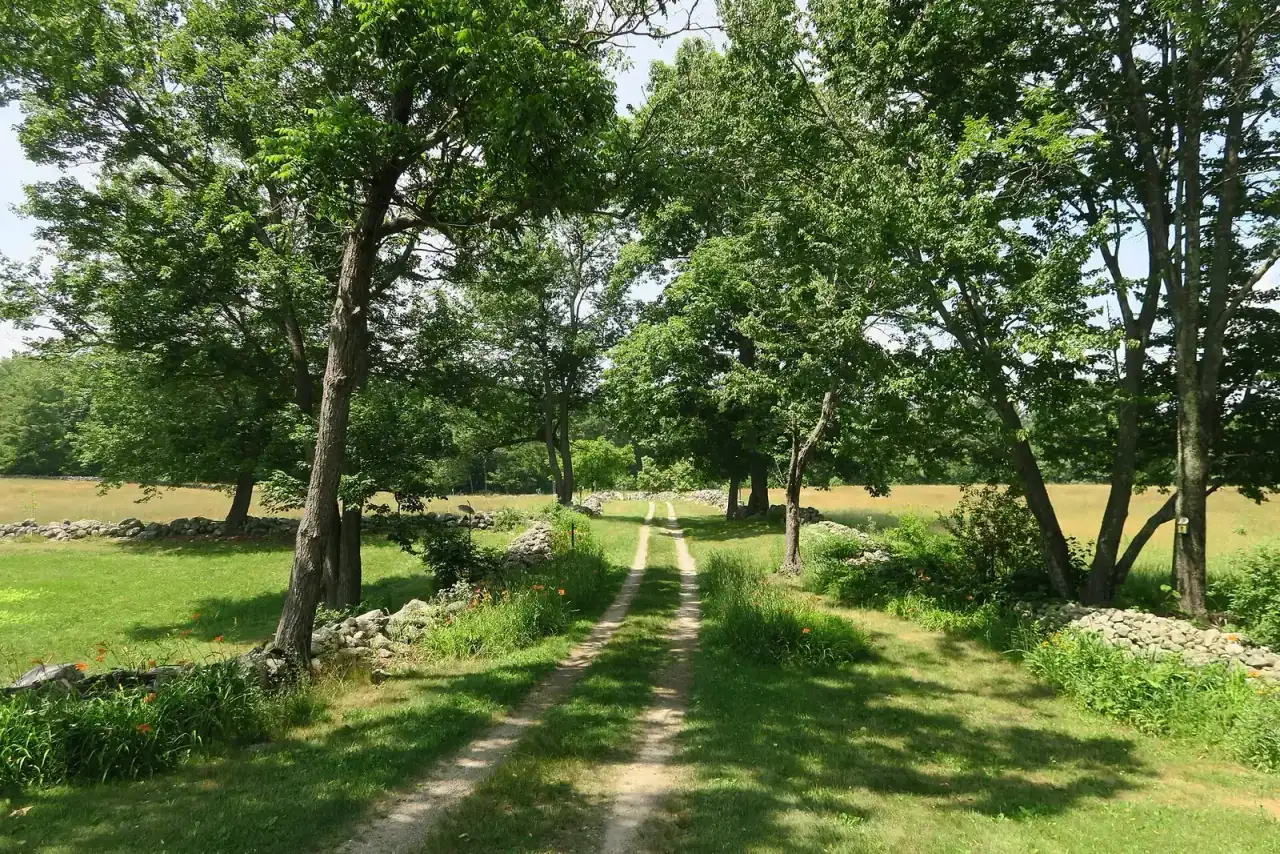
Towns can post seasonal weight limits on Class IV, V and VI roads when a road would otherwise be damaged, and heavy trucks then need written permission from the selectboard or road agent (RSA 231:191). In practice that means gravel, concrete and well-drilling rigs may not reach your lot in March and April. Visit the land during thaw before you buy. If the road is a quagmire in April, it will be every April.
Ask the road agent three questions: is the road posted in spring, does the town plow it to your frontage, and will a driveway be permitted where you want it? Driveway permits on town roads run through the town under RSA 236:13, and on state roads through NHDOT.
Is the land in current use?
A lot of rural New Hampshire land is enrolled in current use, which taxes it at a low rate as long as it stays open. Land generally needs to be at least 10 acres to qualify, with exceptions for wetlands and productive farmland (Town of Jackson). When you develop it, you owe a one-time land use change tax of 10 percent of the full market value of the land that changed (RSA 79-A:7).
The sale itself doesn’t trigger the tax. It is due when construction starts changing the ground: a driveway, utilities, excavation or grading for a building (RSA 79-A:7, IV). The Current Use Board’s shorthand is “when the blade hits the ground” (NHMA and Current Use Board Q&A). The owner at the time of the change owes the tax, so if you buy and then build, it’s yours (NHMA and Current Use Board Q&A). Negotiate the price with that in mind.
Only the changed acreage is taxed, as long as what’s left still qualifies. The house, driveway, septic, lawn and outbuildings come out (Town of Jackson). Carving a small lot out of a current use parcel can trigger the tax at the deed transfer if the piece falls below the minimum acreage (Cub 307.01). There is no buyout: you can’t pay to take land out of current use ahead of time (Town of Jackson).
If the town values the two acres you develop at $60,000, the tax is $6,000, due within 30 days of the bill, with 18 percent annual interest after that (RSA 79-A:7, II). The value is set as of the date of the change, which may not match your purchase price.
Is the land near water or wetlands?
Shoreland
The Shoreland Water Quality Protection Act covers land within 250 feet of lakes and ponds over 10 acres, fourth-order and larger streams and rivers, and designated rivers (NHDES Protected Shoreland FAQ). Inside that zone:
| Rule | Standard |
|---|---|
| House and attached decks | At least 50 feet from the reference line |
| Waterfront buffer (0 to 50 ft) | Natural ground cover stays, except a 6-foot path; tree cutting limited by a point system |
| Woodland buffer (50 to 150 ft) | 25% of the area kept as natural woodland |
| Impervious area over 20% | Stormwater management plan required |
| Impervious area over 30% | Engineer-designed stormwater system required |
| Permit | Most new construction, excavation and fill needs a shoreland permit; small projects (up to 1,500 sq ft of impact and 900 sq ft of new impervious area) may use a permit by notification |
Sources: NHDES SWQPA summary; RSA 483-B:9. Gravel driveways and parking count as impervious. Many towns set bigger setbacks, so check the local ordinance too.
Wetlands
Driveway or road crossings over wetlands or streams, new culverts, and fill in wetlands generally need a state wetlands permit, and NHDES expects you to show you avoided and minimized the impact first, for example by crossing at the narrowest point (NHDES Wetlands FAQ). Since July 1, 2025, the fee for a minimum impact wetlands project is $600 (NHDES fee summary). The state’s wetland rules generally require wetlands to be delineated by a certified wetland scientist (Env-Wt 306.05). If the only route from the road to the dry part of the lot crosses a wet swale, price that crossing before you buy.
Large disturbance
Clearing and grading more than 100,000 square feet (about 2.3 acres), or 50,000 square feet when any of it is in the protected shoreland, needs an Alteration of Terrain permit (NHDES).
Do steep slope or ridgeline rules apply?
Some White Mountains towns regulate building on hillsides, and others are discussing it. Check before you fall for a view lot.
Easton has a Steep Slopes, Hillside and Ridgeline Development Overlay District covering land with an average slope over 15 percent, land above the 1,300-foot contour, and knolls where building would break a forested ridgeline seen from a Class V or better road. Building there needs Planning Board review before a building permit, and the board can ask for grading, lighting, visibility, stormwater and landscaping plans. New lots need at least one contiguous acre under 15 percent slope, and the minimum lot size is 3 or 6 acres depending on how much of the lot is steep (Easton Zoning Ordinance, 2021). The town lists a March 2026 revision of the ordinance, so confirm the current text with the town (Town of Easton).
Bethlehem subtracts slopes of 25 percent or more, along with flood hazard areas and poorly drained soils, when it calculates allowed density for cluster and multifamily developments (Bethlehem Zoning Ordinance, 2025). Sugar Hill’s 2025 master plan calls slopes over 25 percent unsuitable for development and says slopes over 15 percent need special care for erosion and septic (Sugar Hill Master Plan, 2025). Franconia’s 2024 master plan recommends the town look at ridgeline protection rules, for example keeping buildings just below a ridge crest (Franconia Master Plan, 2024). A master plan isn’t zoning, but it tells you where the rules may go.
Even where no ordinance applies, steep ground costs more: hillside septic fields, longer and steeper driveways, and retaining walls.
What should the survey and title search show?
Get a current boundary survey from a licensed land surveyor before closing, with the corners marked. Old stone walls and tax maps are not boundaries. You need accurate lines to check setbacks, the 75-foot well radius, and whether the driveway route stays on your land.
Have a real estate attorney or title company run the title. Look for:
- deeded rights of way across the lot, and whether the lot’s own access is a recorded, assignable right of way;
- utility easements, and any new ones you’ll need from abutters (NHEC, for example, asks for the deed and tax map, may ask for abutters’ deeds, and expects the owner to obtain any easements the line needs (NHEC Terms and Conditions));
- covenants, conservation easements and recorded restrictions, including any Class VI waiver, private road notice or septic flow limit already recorded against the lot;
- current use liens.
Can you get power to it?
Distance is the cost. Eversource includes the first 300 feet of line and charges by the foot after that ($43.12 per foot overhead from June 2025 through March 2026), while NHEC bills the estimated cost minus an allowance of up to $2,400 overhead or $3,200 underground (Eversource tariff; NHEC fees). NHEC won’t schedule a site visit until you have an approved septic plan, a site plan, a roughed-in driveway and a foundation or other sign you’ll finish within a year (NHEC Terms and Conditions), so the septic design comes first here too. Ask the utility for a ballpark before you buy a lot set far back from the road.
How do land loans work in New Hampshire?
Land loans cost more and run shorter than house mortgages:
| Lender (NH) | Published terms |
|---|---|
| Union Bank (northern VT and NH) | Down payments often 25% to 40% (Union Bank) |
| Kennebunk Savings (NH and ME) | Up to 75% financing; town must confirm the lot is buildable; raw land may need more down than improved land (Kennebunk Savings) |
| Holy Rosary Credit Union | Up to 70% loan-to-value, 10-year term; lot must have an approved septic and utility design; 11.865% as of November 14, 2026 (HRCU) |
| Members First Credit Union | 10-year land loan at 8.000% as of November 16, 2026, based on 20% down and a 740 credit score (Members First) |
The spread in those rates is a reason to shop. If you plan to build right away and have permits lined up, a construction loan that covers the land and the house may beat a land loan plus a later construction loan (Kennebunk Savings). Paying cash doesn’t change the due diligence. You still want the septic contingency.
What order should you do things in?
- Read the zoning for the lot’s district: minimum lot size, frontage, setbacks, overlays. Call the planning office.
- Pull the assessor’s card for current use status and the deed for easements and restrictions.
- Sign a purchase agreement with contingencies for septic design, survey, title and financing, with enough time to dig test pits.
- Dig test pits with a septic designer. Ask for a few under the house site and along the driveway route to look for ledge.
- Walk the road with the road agent and get a driveway location you can permit.
- Get a survey and title search.
- Get a utility estimate and look up nearby well records.
- Bring in your builder before closing to look at the house site, driveway and slope together.
Mistakes that cost money
- Buying “back land” reached only by an easement, then finding it has no legal frontage.
- Assuming a Class VI lot is buildable without checking the zoning frontage rule.
- Forgetting the land use change tax in the budget.
- Placing the house for the view first and the septic second.
- Waiving the septic contingency to win a competitive offer.
- Buying in winter without a way to see the ground or the road in mud season.
If you’re looking at land around Littleton, Bethlehem, Franconia, Sugar Hill, Lisbon or Lincoln, Fregeau Builders can walk a lot with you before you commit and help you plan the build as your general contractor. Get in touch. If the parcel already has a seasonal camp on it, see our guide to converting a camp to a year-round home.
Sources
- NH General Court: RSA 674:41, Erection of Buildings on Streets; Appeals (accessed November 2026)
- NH General Court: RSA 229:5, Classification of highways (accessed November 2026)
- NH General Court: SB 281 (2025), final version, Chapter 256 (accessed November 2026)
- NH Office of Planning and Development: 2025 Changes to Planning and Zoning Statutes (accessed November 2026)
- Alfano Law: Building permits on Class VI and private roads in New Hampshire (accessed November 2026)
- Lakes Region Land & Excavation: NH Dirt-Work Costs, 2026 Benchmarks (accessed November 2026)
- O’Connor Landworks: NH Septic Install Cost (2026) (accessed November 2026)
- NH Office of Legislative Services: Env-Wq 1000, Subdivisions; Individual Sewage Disposal Systems (accessed November 2026)
- NHDES: Env-Wq 1000 initial proposal text, July 14, 2026 (accessed November 2026)
- NHDES: Septic Systems (accessed November 2026)
- NHDES: Water Well Construction FAQs (accessed November 2026)
- NHPUC: Eversource Terms and Conditions, line extensions (NHPUC No. 9) (accessed November 2026)
- NHPUC: Eversource line extension technical statement and tariff, Docket DE 25-012 (accessed November 2026)
- NH General Court: RSA 231:191, Maximum Weight Limits (accessed November 2026)
- NH General Court: RSA 236:13, Driveways and Other Accesses to the Public Way (accessed November 2026)
- NH General Court: RSA 79-A:7, Land Use Change Tax (accessed November 2026)
- NH Municipal Association and Current Use Board: Current Use Questions (accessed November 2026)
- Town of Jackson: Current Use Program (accessed November 2026)
- Cornell LII: N.H. Admin. Code Cub 307.01, When Current Use Land is Changed (accessed November 2026)
- NHDES: Protected Shoreland FAQ (accessed November 2026)
- NHDES: Shoreland Water Quality Protection Act, summary of minimum standards (accessed November 2026)
- NH General Court: RSA 483-B:9, Minimum Shoreland Protection Standards (accessed November 2026)
- NHDES: Wetlands and Stream Crossings FAQs (accessed November 2026)
- NHDES: Fee changes included in the 2026-2027 state budget (accessed November 2026)
- NHDES: Env-Wt 300 wetland rules (accessed November 2026)
- NHDES: Alteration of Terrain Permitting (accessed November 2026)
- Town of Easton: Zoning Ordinance, revised March 9, 2021 (accessed November 2026)
- Town of Easton: Ordinances and Permits (accessed November 2026)
- Town of Bethlehem: Zoning Ordinance, amended March 11, 2025 (accessed November 2026)
- Town of Sugar Hill: 2025 Master Plan (accessed November 2026)
- Town of Franconia: Master Plan 2024 (accessed November 2026)
- NHEC: Terms and Conditions (accessed November 2026)
- NHEC: Schedule of Fees, effective January 1, 2026 (accessed November 2026)
- Union Bank: Land Loans (accessed November 2026)
- Kennebunk Savings: Land Loans in NH and ME (accessed November 2026)
- Holy Rosary Credit Union: Mortgages and Home Loans (accessed November 2026)
- Members First Credit Union: Mortgage Rates (accessed November 2026)