A new house in New Hampshire has to meet the 2018 IECC with state amendments: in Grafton, Coos and Carroll counties that means climate zone 6 insulation (R-49 ceilings, R-20 plus R-5 continuous wall insulation or equivalent) and a blower door result no worse than 5 air changes per hour at 50 pascals (NH EC-1 form). A cold-climate heat pump sized to that house can carry most of the winter, with a wood stove or propane as backup. The federal tax credits are gone: the IRS says 25C and 25D ended December 31, 2025, and 45L ended for homes acquired after June 30, 2026. What is left is mainly NHSaves’ ENERGY STAR Homes program, worth up to $10,000 plus a $500 bonus, if your electric utility participates and you enroll before you break ground.
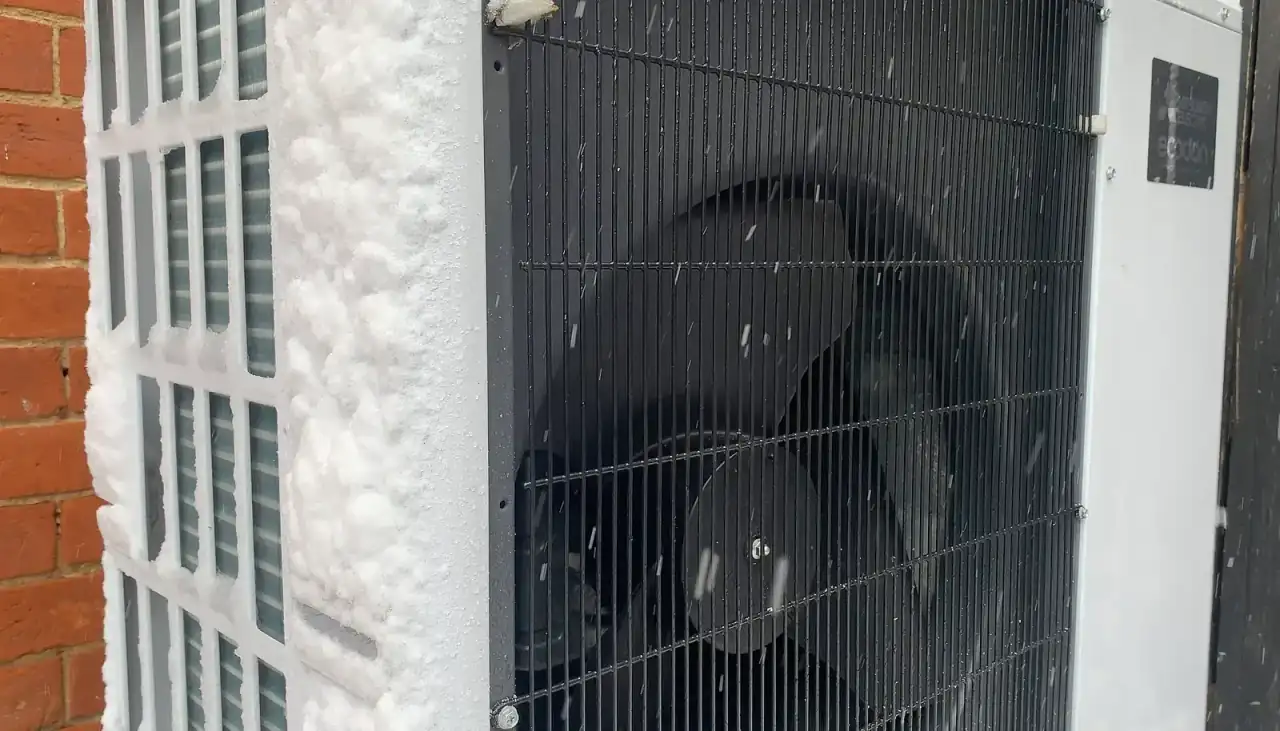
Do cold-climate heat pumps really work at -20°F?
They keep running. The useful numbers are how much heat they deliver at that temperature and what that heat costs.
How cold does it get, for design purposes?
Heating systems are sized to a “99% design temperature,” the outdoor temperature that is colder for only about 88 hours a year (EPW.tools explainer). A published Manual J climate table lists that figure as -11°F at Berlin and -3°F at Lebanon (ManualJs.com NH climate table). Littleton has no station of its own, so your designer has to pick the closest fit, and for a house in the hills Berlin’s number is the safer one. Those roughly 88 hours below the design number, including the -20°F nights, are the ones a well-designed system covers with backup heat rather than an oversized heat pump.
What “cold climate” means on a spec sheet
The Northeast Energy Efficiency Partnerships (NEEP) cold-climate specification, version 4.0, requires a variable-speed compressor, a COP of at least 1.75 at 5°F at maximum capacity, and published performance data down to the lowest temperature the maker lists. NHSaves’ heat pump rebate table for New Hampshire Electric Cooperative members uses the same 1.75 at 5°F threshold (NHSaves heat pumps).
For one 1.5-ton cold-climate wall unit (Mitsubishi MUZ-GX18NLHZ), the manufacturer’s submittal sheet lists:
| Outdoor temp | Max heating output | COP at max output |
|---|---|---|
| 47°F | 27,400 Btu/h (19,000 rated) | 4.16 at rated output |
| 5°F | 19,000 Btu/h | 1.8 |
| -10°F | 15,150 Btu/h | 1.7 |
| -22°F | 10,700 Btu/h | not listed |
At -22°F that unit still puts out about 56% of its rated 19,000 Btu/h at 47°F. Size equipment by the heat it delivers at your design temperature, not the number on the box.
What field studies in New England found
Metered homes are better evidence than lab ratings.
| Study | Homes | Key finding |
|---|---|---|
| MA/CT Heat Pump Metering Study, 2024 | 185 homes, Nov 2022 to May 2024 | Below 5°F, average compressor-on COP of about 2.0 (range 1.6 to 2.3), measured at 20 sites during the February 2023 cold snap |
| Efficiency Maine whole-home study, 2026 | 160 metered heat pumps | Homes used about 4,904 kWh a year to deliver about 52 million Btu of heat; seasonal COP averaged 3.15 per a companion ACEEE paper |
| DOE Building America, CT/MA/VT, 2013 to 14 | 7 homes | Delivered rated capacity down to -10°F, but monthly COPs ranged from 1.1 to 3.1 depending on installation |
Heat pumps work through New England winters, and newer equipment does better than older equipment. Installation and controls matter as much as the brand: the Building America team traced poor results to low airflow, badly placed outdoor units and occupants turning fan speeds down. In the MA/CT study, about half the homes kept a backup system, and three-quarters of those owners ran it during the coldest periods.
For new construction, a few details are worth getting right: a manual J load calculation (not a rule of thumb), outdoor units on stands above the snow line and out from under roof drip edges, and a ducted or ductless layout that actually reaches the bedrooms.
What backup heat makes sense in the North Country?
Every heat pump needs electricity, and North Country ice storms take the power out. That alone is a reason to have a second heat source that does not depend on the grid.
The NH Department of Energy publishes heating costs per million Btu delivered. As of November 2, 2026:
| Heat source | Price | Cost per million Btu delivered |
|---|---|---|
| Heat pump (COP 2.5) | $0.26/kWh | $30.36 |
| Wood pellets | $412.36/ton | $31.24 |
| Cord wood | $458.82/cord | $45.88 |
| Heating oil (80% efficient) | $6.03/gal | $54.41 |
| Propane (80% efficient) | $4.26/gal | $58.37 |
| Electric resistance | $0.259/kWh | $75.91 |
Source: NH Department of Energy, NH Fuel Prices. Propane and oil prices are statewide averages; your dealer’s price may differ.
On a subzero night, at $0.26 per kWh and a COP of 1.7 (the -10°F figure above), heat pump heat costs $0.26 ÷ (3,412 Btu × 1.7) × 1,000,000 ≈ $44.80 per million Btu, still cheaper than propane at $58.37. The heat pump only loses to propane on cost below a COP of about 1.3, and electric resistance strips are the most expensive heat on the list.
If you are on Littleton Water & Light, the math tilts further toward electricity. LW&L’s 2026 residential rate adds up to about $0.135 per kWh before the $8 monthly customer charge (LW&L rate schedule), which works out to roughly $15.80 per million Btu at a COP of 2.5.
We usually size the heat pump to cover most of the design load. Efficiency Maine requires a whole-home system to cover at least 80% of the design load, with supplemental heat making up the rest (Efficiency Maine 2026 study), and that is a sensible rule of thumb here too. If you have a wood supply and want to run it, a wood stove adds resilience, and cord wood is cheaper than propane per Btu.
Propane makes sense where you already need it for cooking, a generator or a backup heater. A small propane heater on a separate thermostat set a few degrees lower works as “droop control,” the arrangement the MA/CT study describes. Avoid relying on electric resistance strips as the main backup, since they are the most expensive heat in the state.
What insulation and air sealing does New Hampshire require?
Your climate zone
Under the 2018 IECC climate map that New Hampshire uses, Belknap, Carroll, Coos, Grafton, Merrimack and Sullivan counties are zone 6A. Littleton, Bethlehem, Franconia, Sugar Hill, Lisbon, Lincoln and Easton are in Grafton County; Whitefield is in Coos. All are zone 6.
The code minimums, and what we would aim for
New Hampshire kept the 2018 IECC when it moved its other codes to the 2024 editions on July 1, 2026 (NH Division of Fire Safety). The newer 2021 IECC, which New Hampshire has not adopted, is a fair benchmark for “better than code.”
| Component | NH code, zone 5 | NH code, zone 6 | 2021 IECC, zones 5 to 6 (benchmark) |
|---|---|---|---|
| Attic ceiling | R-49 (R-38 with raised-heel truss) | R-49 (R-38 with raised-heel truss) | R-60 |
| Wood-frame wall | R-20, or R-13 + R-5 continuous | R-20 + R-5, or R-13 + R-10 | R-30, or R-20 + R-5, or R-13 + R-10 |
| Basement wall | R-15 continuous or R-19 cavity | R-15 continuous or R-19 cavity | R-15 continuous, R-19, or R-13 + R-5 |
| Slab edge | R-10, 2 ft | R-10, 4 ft | not compared |
| Windows | U-0.30 | U-0.30 | not compared |
| Air leakage | 5 ACH50 | 5 ACH50 | 3 ACH50 (model 2018 IECC) |
Sources: NH EC-1 form and NH-amended IECC text; 2021 IECC values via Nail the Math, citing PNNL and Table R402.1.3; model-code air leakage from DOE’s 2018 IECC summary.
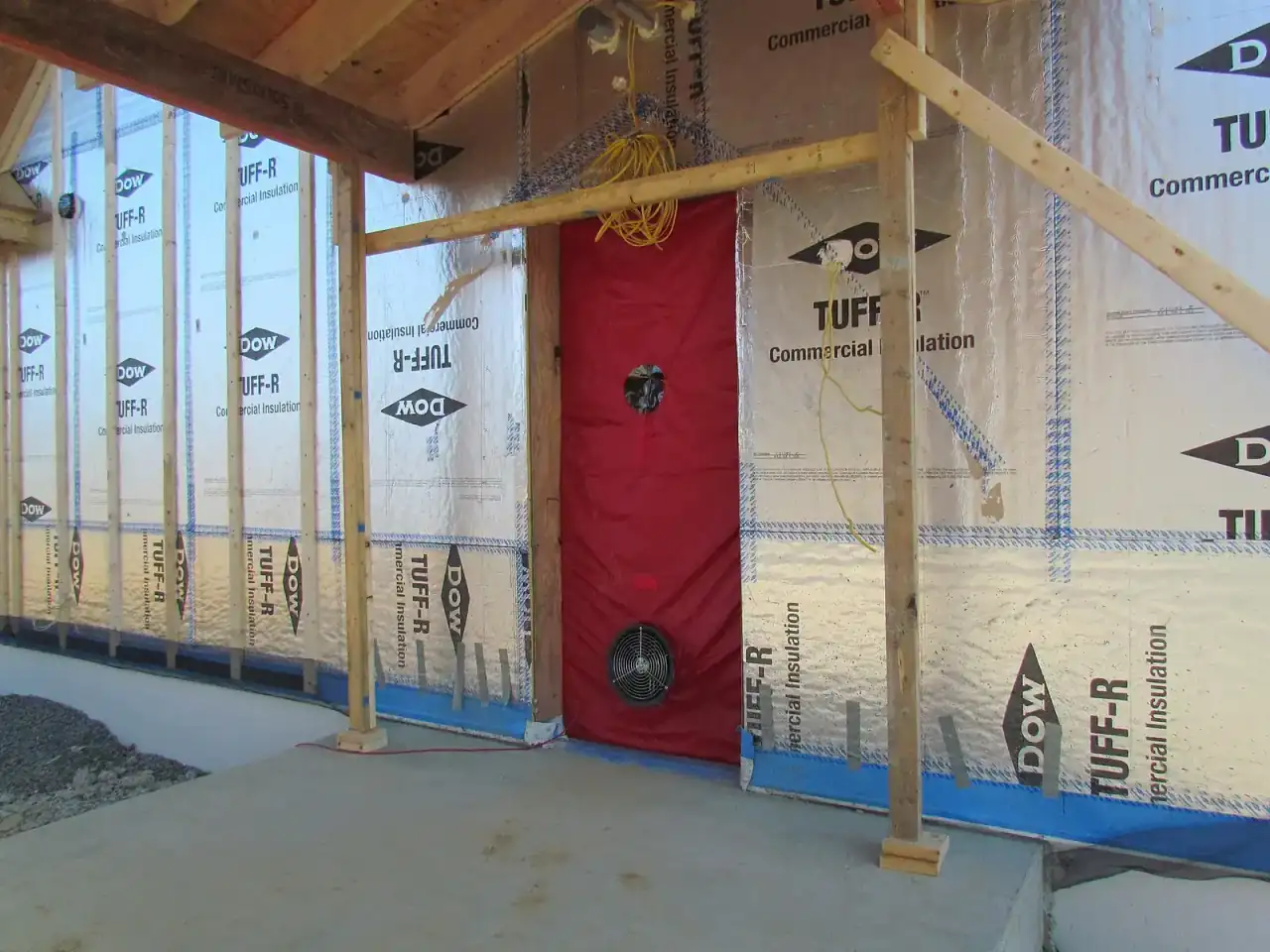
Why 5 ACH50 is a low bar
The model 2018 IECC limits new homes in zones 3 through 8 to 3 ACH50. New Hampshire changed that in 2024: SB 373 directed the code board to set the maximum at 5.0 ACH50 under any compliance path, effective July 3, 2024. Older guides, including a 2022 Concord code bulletin, still cite 3 ACH50, so you will see both numbers. The current state form says 5.
Air leakage drives heating load in a cold, windy climate, and it is cheap to fix during framing and expensive to fix later. We tell clients to aim well under 3 ACH50, and to schedule a blower door test before drywall, while leaks can still be found and sealed. A tight house also needs mechanical ventilation, usually a heat- or energy-recovery ventilator, so plan for it from the start.
Paperwork
Every new house files the state’s EC-1 energy form. In some towns it goes to the NH Department of Energy instead of the local building inspector; the state’s list includes Littleton, Franconia, Sugar Hill, Easton, Lincoln and Whitefield. Our post on snow load, frost depth and the building code in northern New Hampshire covers the structural side of the same code update.
What rebates and incentives are left in late 2026?
| Program | What it pays | Status, November 2026 |
|---|---|---|
| Federal 25D (solar, geothermal, batteries) | Was 30% | Ended for expenditures after Dec. 31, 2025 |
| Federal 25C (heat pumps, insulation, windows in existing homes) | Was 30% | Ended for property placed in service after Dec. 31, 2025 |
| Federal 45L (builder credit for ENERGY STAR homes) | Was $2,500 to $5,000 per home | Ended for homes acquired after June 30, 2026 |
| NHSaves ENERGY STAR Homes | $1,500 base plus per-point HERS incentives, max $10,000; +$500 ENERGY STAR bonus; free HERS rating | Open for Eversource, Liberty, NHEC and Unitil customers; enroll before construction |
| NHSaves Net Zero Challenge | Prizes of $5,000, $2,000 and $1,000 | Open to ENERGY STAR-certified homes |
| HEAR (federal, run by NH DOE) | Up to $8,000 for a heat pump; $14,000 household max | Households up to 150% of area median income; new or existing single-family homes; not yet open |
Sources: IRS FAQ FS-2025-05; 26 U.S.C. 45L; NHSaves 2026 ENERGY STAR Homes enrollment form; NH DOE HEAR page; Energy Saver NH.
The federal credits, precisely
For 25D, the IRS counts an expenditure as made when installation is complete, and for a newly built home, when you first move in. A house finished and occupied in 2026 does not qualify, even if you paid for the solar array in 2025. One caution: the IRS’s general Residential Clean Energy Credit page still mentions a phase-out “in 2033” in one paragraph, a leftover from the old law. The Form 5695 instructions and the IRS FAQ both state the December 31, 2025 end date, and they control.
NHSaves new homes: how it works
The 2026 enrollment form sets the incentive by how far your home’s HERS index beats the ENERGY STAR target: $1,500 for meeting it, then $100 per point for the first 10 points below, $250 per point for points 11 to 20, $500 for 21 to 30 and $1,000 per point beyond 31, capped at $10,000 for a single-family home. ENERGY STAR certification adds $500. The utility also pays for the HERS rater; the form values that at $2,000, while the NHSaves web page says $1,500.
The rules that trip people up:
- The signed enrollment must reach your utility before construction starts.
- The rater inspects all insulation before drywall, then runs the blower door and duct tests at completion.
- Homes must be complete by December 31, 2026 to use the 2026 terms; later homes sign an updated agreement. We could not find 2027 terms published yet.
- You cannot also take NHSaves’ separate heat pump, water heater or appliance rebates on the same house.
If your power comes from Littleton Water & Light
NHSaves programs require you to be a customer of a participating utility: Eversource, Liberty, NHEC or Unitil. Littleton Water & Light is a municipal utility and is not one of them. We did not find a new-construction rebate on LW&L’s website. Call them before you count on any utility incentive. The upside is LW&L’s lower electric rate.
Does solar make sense on a new New Hampshire house?
Net metering for most utilities
For systems up to 100 kW on Eversource, Liberty and Unitil, power you use is netted against power you produce each month. Surplus is credited at the default energy service rate plus the transmission charge plus 25% of the distribution charge (Eversource NH net metering). The PUC left those terms in place in November 2024 and set a single end date: systems connected under the current tariff keep it until December 31, 2040 (RSA 362-A:9, ISO-NE summary of PUC Order 27,074). The PUC opened a further investigation in 2025 (docket IR 25-031) and has signaled interest in time-of-use rates for future customers.
Littleton Water & Light is different
LW&L sets its own rules (interconnection rules, 2026 rates):
- Systems are capped at 7.2 kW DC on standard single-phase residential service.
- Exported power earns a credit of $0.09924 per kWh, less than the roughly $0.135 you pay.
- Unused credits reset to zero every December 31.
- Total net-metered capacity on the system is capped at 2% of LW&L’s annual peak, first come, first served, and applications are due 90 days before installation.
Our take
Without the 30% federal credit, solar on a new house pays back more slowly than it did in 2025. What is cheap during construction is making the house solar-ready: a south-facing, unshaded roof plane free of vents and chimneys, roofing rated for a long life, and a conduit run from attic to panel. You can add panels later when prices or policy change.
What pays back, and what does not?
| Upgrade | Cost | What you get back | Sources |
|---|---|---|---|
| HERS rating and blower door testing | $0 through NHSaves (valued at $1,500 to $2,000) | Code-required test plus rebate eligibility | NHSaves form and web page |
| NHSaves ENERGY STAR enrollment | Paperwork before you build | $1,500 to $10,000, plus $500 bonus | NHSaves 2026 form |
| Whole-home cold-climate heat pump | About $7,000 to $7,200 per ton installed in Massachusetts program data (2024, Aug. 2025 dollars); new-construction whole-home installs averaged about $13,200 (2024 dollars) in a MassCEC pilot | Heat at about $30/MMBtu vs. $58 for propane | NMR heat pump pricing study, 2026; NEEP market assessment; NH DOE |
| Going from 5 to under 3 ACH50 | Labor and materials during framing; get a quote | Lower heating load, smaller heat pump | Code tables above |
| Solar array | Full price in 2026, no federal credit | Credits under NEM 2.0 through 2040; less on LW&L | Eversource; LW&L |
The homes in Efficiency Maine’s study delivered about 52 million Btu of heat a year. At NH DOE’s November 2026 prices, that much heat costs about $3,035 with propane (52 × $58.37) and about $1,579 with a heat pump (52 × $30.36), a difference of roughly $1,450 a year. Those Maine homes are mostly existing houses, and a tight new house built to the targets above should need less heat, which shrinks both bills and the size of the heat pump you have to buy.
Where we would spend first, in order: air sealing and insulation during framing, a properly sized heat pump with a wood or propane backup, then solar-ready roof and wiring. Of the four, the envelope is the only one you cannot easily upgrade later. If you are pricing a whole house, our guide to what it costs to build a house in New Hampshire puts these choices in context.
Fregeau Builders builds custom homes in Littleton and the White Mountains. If you want to talk through envelope and heating choices for your lot, contact us.
Sources
- IRS: FAQs for modification of sections 25C, 25D, 25E, 30C, 30D, 45L, 45W and 179D under Public Law 119-21 (FS-2025-05) (accessed November 2026)
- IRS: Instructions for Form 5695 (2025) (accessed November 2026)
- IRS: Residential Clean Energy Credit (accessed November 2026)
- US House Office of Law Revision Counsel: 26 U.S.C. 45L (accessed November 2026)
- UpCodes: New Hampshire Energy Conservation Code 2018, Chapter 4 RE, including NH EC-1 form (accessed November 2026)
- UpCodes: New Hampshire Energy Conservation Code 2018, Chapter 3 CE, climate zones by county (accessed November 2026)
- LegiScan: NH SB 373 (2024), air leakage amendment (accessed November 2026)
- City of Concord: Energy Code Bulletin 2022-01 (accessed November 2026)
- US DOE Building Energy Codes Program: Residential Provisions of the 2018 IECC (accessed November 2026)
- Nail the Math: New Hampshire Climate Zones by County (accessed November 2026)
- NH Division of Fire Safety: State Building Code (accessed November 2026)
- NH Department of Energy: Energy Codes and EC-1 submission list (accessed November 2026)
- NEEP: Cold Climate Air Source Heat Pump Specification, Version 4.0 (accessed November 2026)
- Mitsubishi Electric: MSZ-GX18NL / MUZ-GX18NLHZ submittal (accessed November 2026)
- EPW.tools: Manual J design temperatures (accessed November 2026)
- ManualJs.com: New Hampshire Climate Data (accessed November 2026)
- MA EEAC / CT: Heat Pump Metering Study (MA22R51-B-HPMS / CT R2246) (accessed November 2026)
- Efficiency Maine: Assessment of Heat Pumps in Maine Homes (2026) (accessed November 2026)
- ACEEE: How to Maximize Heat Pump Use in Cold Climates (2026) (accessed November 2026)
- US DOE Building America: Field Performance of Inverter-Driven Heat Pumps in Cold Climates (accessed November 2026)
- NH Department of Energy: NH Fuel Prices (November 2, 2026) (accessed November 2026)
- NHSaves: Residential New Home Construction (accessed November 2026)
- NHSaves: 2026 ENERGY STAR Homes Program Enrollment Form (accessed November 2026)
- NHSaves: Heat Pumps (accessed November 2026)
- NH Department of Energy: Home Electrification and Appliance Rebates (HEAR) (accessed November 2026)
- Energy Saver New Hampshire (accessed November 2026)
- Littleton Water & Light: 2026 Schedule of Water & Electric Rates (accessed November 2026)
- Littleton Water & Light: Interconnection Rules for Net Energy Metering Systems (accessed November 2026)
- Eversource: New Hampshire Net Metering (accessed November 2026)
- NH General Court: RSA 362-A:9 Net Energy Metering (accessed November 2026)
- ISO New England: NH DG Forecast Working Group update on PUC Order 27,074 (Dec. 2024) (accessed November 2026)
- NH PUC: Docket IR 25-031, Investigation Into Distributed Generation (accessed November 2026)
- NMR Group for MA PAs: Heat Pump Pricing Study (March 2026) (accessed November 2026)
- NEEP: Northeast High-Performance HVAC Market Assessment (accessed November 2026)