In New Hampshire, a standing seam metal roof costs roughly two to three times as much as architectural asphalt shingles and can last about twice as long. A Seacoast NH roofer quotes $5.50 to $8.50 per square foot installed for architectural shingles and $14 to $22 for standing seam, and another NH and Massachusetts roofer puts a full standing seam roof at roughly double an asphalt roof. Exposed-fastener metal sits in between. In the North Country, the choice usually turns on how long you will own the house, where the snow will land, and whether the attic underneath is built to stop ice dams.
How much does a metal roof cost compared with shingles in New Hampshire?
Roofers price by the square, which is 100 square feet of roof surface. Roof area is larger than floor area because of pitch and overhangs.
Cost and lifespan side by side
| Architectural asphalt | Exposed-fastener metal (screw-down) | Standing seam metal | |
|---|---|---|---|
| NH installed price per sq ft (Seacoast roofer, 2026) | $5.50 to $8.50 | $9.00 to $13.50 | $14.00 to $22.00 |
| Per square (100 sq ft) | $550 to $850 | $900 to $1,350 | $1,400 to $2,200 |
| NH/MA full-roof range, one roofer’s jobs (2025-2026) | $12,500 to $22,000 (NH) | About 1.25 × asphalt | $21,000 to $42,000 |
| Estimated life, InterNACHI | 30 years | 40 to 80 years (metal overall) | 40 to 80 years (metal overall) |
| Realistic NH life, per one NH roofer | 25 to 35 years | 30 to 40 years; screw gaskets start leaking around year 20 | 50+ years, often 60 to 70 |
| Code minimum slope (2024 IRC) | 2:12, with double underlayment up to 4:12 | 3:12 without lap sealant | 1/4:12 |
| Typical install time, 2,400 sq ft roof | 1 to 2 days | 2 to 3 days | 3 to 5 days |
Sources: Compass Exteriors, Stratham NH (prices, NH service life, install time); Nick Tracey Roofing (full-roof ranges from its signed jobs); InterNACHI life expectancy chart; UpCodes, NH Residential Code 2024, Chapter 9 (slopes).
Nick Tracey Roofing’s ranges come from its own signed jobs: 42 standing seam roofs in New Hampshire and Massachusetts, and asphalt replacements signed in 2025 and 2026 (Nick Tracey Roofing). For an independent check on the metal side, the Remodeling 2025 Cost vs. Value Report (www.costvsvalue.com) estimates that tearing off an old roof and installing 3,000 square feet of prefinished standing seam, with an ice-barrier membrane at the perimeter and synthetic underlayment over the rest, costs $56,282 in New England, or about $1,876 per square by our division. That is an estimate for a simple hip roof with two skylights, not a survey of invoices. © 2025 Zonda Media, a Delaware Corporation. Complete data from the Remodeling 2025 Cost vs. Value Report can be downloaded free at www.costvsvalue.com.
The math on a typical roof
Take a 2,400 sq ft roof, 24 squares, at the Seacoast prices above:
- Architectural asphalt: 2,400 × $5.50 to $8.50 = $13,200 to $20,400
- Exposed-fastener metal: 2,400 × $9.00 to $13.50 = $21,600 to $32,400
- Standing seam: 2,400 × $14.00 to $22.00 = $33,600 to $52,800
Those are southern NH prices. We haven’t found a published price list from a North Country roofer, and travel time, steeper roofs and snow guards can push a White Mountains job higher. Use these numbers as a starting point and get two written quotes that list the same scope.
Cost per year of service
Spread over its life, the gap narrows but doesn’t always close. At the midpoints, $16,800 for asphalt over 30 years is $560 a year. $43,200 for standing seam over 50 years is $864 a year; stretch it to 60 years and it is $720. The Stratham roofer runs its own version: a $20,000 asphalt roof that lasts 27 years works out to about $740 a year, a $42,000 steel roof over 50 years to about $840. Metal wins on cost only if it lasts well past 50 years, the asphalt roof wears out early, or you count the hassle of a second tear-off as worth real money.
How long does each roof last in a New Hampshire winter?
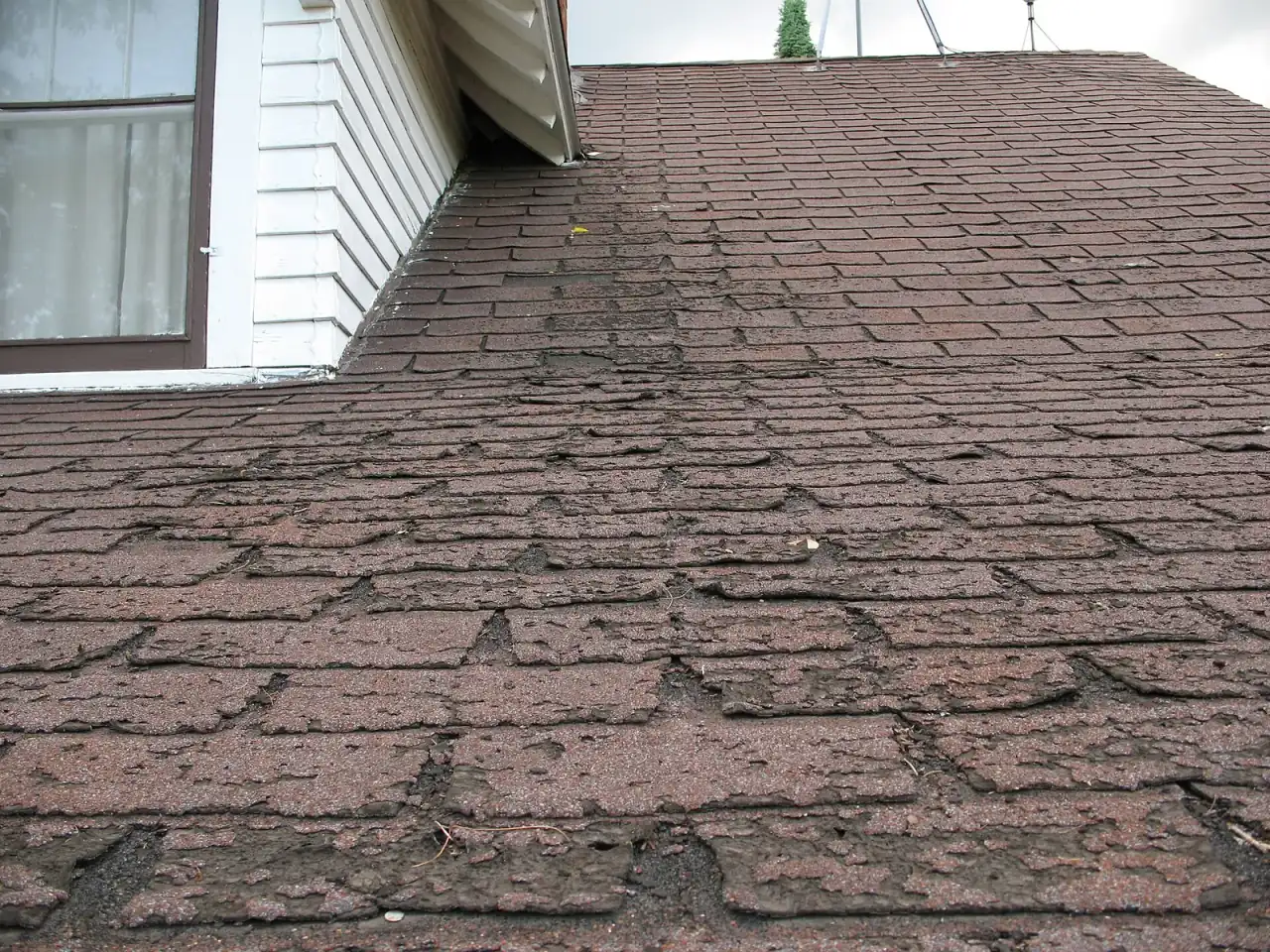
InterNACHI, the home inspectors’ association, estimates 20 years for 3-tab shingles, 30 for architectural and 40 to 80 for metal, assuming normal maintenance. The Stratham roofer’s field numbers for NH are a little lower for asphalt, 25 to 35 years, and it notes that a poorly vented attic “can cut an asphalt roof’s life by a third” (Compass Exteriors).
The two metal systems age differently. Standing seam hides its fasteners under the seams and lets panels move with temperature. Its paint finish fails before the steel does, and the same roofer says a good PVDF (Kynar 500) coating goes 40 years or more before it starts to chalk or fade. Exposed-fastener panels are screwed through the face, and every screw has a rubber washer that dries out over time. The roof needs periodic checks and screw replacement, which is why the same roofer gives it 30 to 40 years.
Freeze-thaw is hard on asphalt: water gets into cracks, freezes and widens them each winter. Sheet metal doesn’t have that failure mode.
What happens to the snow?
This is the biggest practical difference in the North Country. Asphalt holds snow on the roof. A smooth metal roof sheds it, often all at once.
Where sliding snow lands
The Army Corps of Engineers’ Cold Regions Research and Engineering Laboratory (CRREL) in Hanover warns that snow and ice sliding off pitched metal roofs can damage property and injure people 20 to 30 feet from a two-story building. Its first recommendation is a design fix: put entrances at the gable ends, where nothing slides. CRREL calls snow guards a “poor solution” to problems that better-placed doors would avoid.
On a new house, that means placing these items away from the eaves of a metal roof, or under a gable:
- entry doors, mudroom doors and the path to the driveway;
- the propane tank, generator and heat pump outdoor units;
- decks, porch roofs and any lower roof that would take the impact;
- the garage door, and where you park.
On a renovation you rarely get to move the door, so snow guards come in. Our guide to designing a house for the New Hampshire climate covers roof shape and entry placement in more depth.
Snow guards: what good design looks like
A snow guard holds snow on the roof so it melts or falls in small pieces. It has to resist the full sliding force of the snow above it. The International Institute of Building Enclosure Consultants shows the math: design roof snow load × the sine of the roof angle × the rafter length × the seam spacing. A 35 psf roof snow load on a 6:12 roof, 40 feet from eave to ridge, with seams 18 inches apart, puts about 939 pounds on each seam (IIBEC). North Country roof snow loads are often much higher than 35 psf. Our snow load and frost depth guide lists the ground loads by town.
Guidance from snow guard makers, citing the Metal Construction Association, says to protect the whole eave rather than a short section over a doorway, which they call “potentially a dangerous practice,” and to size the system with calculations for your specific roof (ATAS International). Ask the roofer for the snow guard layout and the load calculation in writing. Clamp-on guards for standing seam don’t puncture the panel. Guards on exposed-fastener roofs are screwed through it.
Gutters under a metal roof
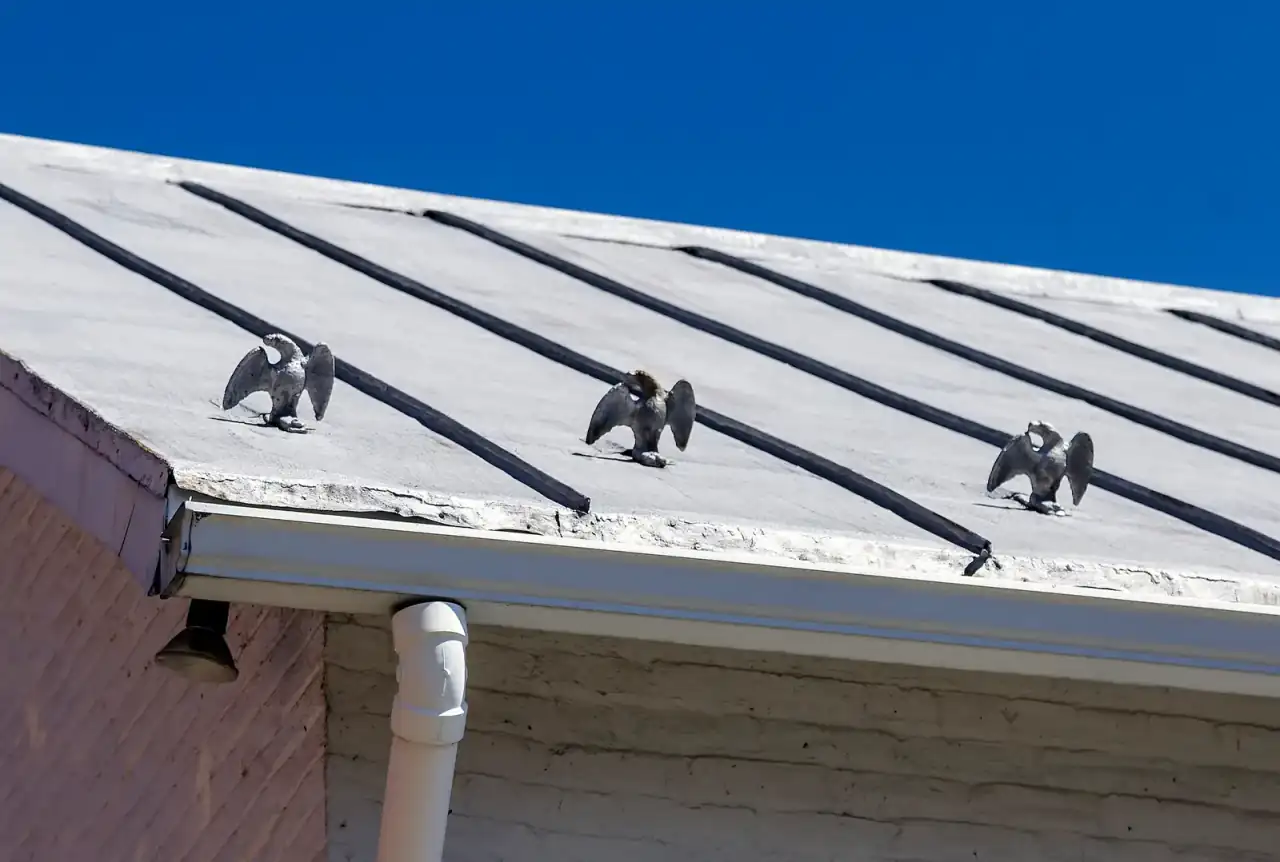
Snow sliding off a metal roof will tear off a gutter that sits in its path. Gutters need to be mounted low enough that the slide passes over them, with close bracket spacing, or left off where the roof dumps snow.
Does a metal roof stop ice dams?
It reduces them. Ice dams form when house heat melts snow on the roof and the water refreezes at the cold eave. A metal roof sheds the snow before much of it can melt, so there is less to refreeze, and the Stratham roofer calls metal “the last-ditch fix that actually works” for houses that still dam after air sealing and insulation (Compass Exteriors).
But the cause is still heat leaking into the attic. A leaky attic under metal still melts snow from below, and you get ice at the eave or icicles that come down with the next slide. CRREL expects sliding snow and falling ice from any roof that drains to a cold eave. On a new house, build the roof right first: an airtight ceiling, full-depth insulation over the wall plates, and a continuous vent channel under the deck. We go through that in the snow load guide. Then choose the roofing.
What does the New Hampshire code require under the roof?
New Hampshire’s state building code moved to the 2024 International Residential Code on July 1, 2026. Permits filed through December 31, 2026 can use either the 2021 or 2024 code, and from January 1, 2027 every permit follows the 2024 edition (NH Division of Fire Safety). Roofing requirements from the NH edition of the 2024 IRC (UpCodes, Chapter 9):
| Requirement | Asphalt shingles | Metal panels (standing seam, exposed fastener) |
|---|---|---|
| Ice barrier where the town’s code table records ice damming (R905.1.2) | Required: two layers of underlayment cemented together or self-adhering membrane, from the eave to at least 24 in. inside the exterior wall line; at least 36 in. up the slope on roofs 8:12 or steeper | Not listed in R905.1.2 (metal shingles are) |
| Underlayment | Per R905.1.1; double layer on slopes from 2:12 to 4:12 | Per R905.1.1 (R905.10.6) |
| Wind | Shingles tested to ASTM D7158 (or D3161) and labeled with the class required for the site’s design wind speed (R905.2.4.1) | Panels tested to UL 580, FM 4474, UL 1897 or ASTM E1592 and installed for the code’s wind loads (R905.10.5) |
| Fasteners | Galvanized, stainless, aluminum or copper nails, at least 4 per strip shingle | Per manufacturer; galvanized for steel roofs if no instructions |
| Deck | Solid sheathing | Solid deck, or spaced sheathing only where the panel is designed for it (R905.10.1) |
In practice, assume you need the ice barrier. The requirement turns on the town’s code table entry for ice damming, so in the North Country, plan on it and confirm with the building inspector.
Put membrane under metal panels as well. The code doesn’t list standing seam panels in the ice barrier section, but the standing seam job priced in the Remodeling 2025 Cost vs. Value Report includes an ice-barrier membrane at the roof perimeter, and snow and ice still build up at eaves and valleys on metal roofs. Leaving the membrane out to save a few hundred dollars is a bad trade.
Which roof handles wind better?
Both can meet code for NH design wind speeds when installed to the manufacturer’s instructions. The Stratham roofer says architectural shingles typically carry a 110 to 130 mph wind warranty when installed with six nails per shingle and high-wind starter strips, and that it has installed standing seam panels rated to 140 mph or more (Compass Exteriors). Open hilltop and ridge lots, the ones with the views, get the most wind. Ask what wind class the shingle is labeled for, or what test the metal panel passed, and get the nailing or clip spacing in writing.
Is a metal roof noisy?
On a house with a solid deck, not by much. A metal roofing manufacturer’s summary of a study by the acoustics group at Luleå University in Sweden puts rain on metal about 6 decibels louder than on asphalt shingles, and notes that metal over open framing is louder. The source sells metal roofing, so weigh it accordingly.
Two kinds of noise come up in New England reports and rarely in sales literature: the tick of panels expanding when the sun hits them, and the thump of snow sliding off at night. A porch or garage with metal screwed to purlins and no ceiling will be loud in rain. If that matters, put a solid deck and underlayment under it.
How does a metal roof affect home insurance in New Hampshire?
There is no NH rule that requires insurers to discount metal roofs. What matters is how your policy settles a roof claim. Ask your agent:
- Replacement cost or actual cash value? Actual cash value subtracts depreciation for the roof’s age. The NH Insurance Department notes that an insurer only has to pay to repair the part of a roof damaged by a covered peril, not to replace a roof that is worn out (NHID).
- Is there a cosmetic damage exclusion for metal? Some policies exclude dents in metal roofing that don’t let water in (Vantage Point Risk). A dented roof that still keeps water out may get nothing.
- Is there a discount for impact-resistant roofing? The Stratham roofer reports discounts of 5 to 15% from some carriers for impact-resistant metal or Class 4 shingles. It isn’t automatic.
- What roof age is on file? An older asphalt roof can trigger an inspection, a switch to actual cash value, or nonrenewal. In February 2025 the NH Insurance Department told insurers they can’t refuse or nonrenew based only on cosmetic issues such as roof discoloration seen in aerial photos, and must do a physical inspection if the imagery isn’t conclusive or the owner disputes it (NHID bulletin).
Does a metal roof add resale value?
Less than it costs. The Remodeling 2025 Cost vs. Value Report estimates that the New England standing seam replacement described above adds $21,904 to a home’s resale value, 38.9% of its $56,282 cost. That figure comes from real estate agents’ estimates, not sale prices. A roof is maintenance buyers expect, so plan to get your money back from the years of service, not from the sale.
Style matters too. The Stratham roofer says standing seam looks right on farmhouses, barn-style houses and lake camps, and can look out of place on a colonial in a neighborhood of shingled roofs (Compass Exteriors).
What do New England homeowners report?
These are individual reports from Reddit, not data.
In a 2024 r/vermont thread, one homeowner said a 40-square standing seam roof cost about $28,000 in 2017, including stripping two layers of shingles. Another was quoted over $30,000 for a small cape and chose asphalt at about half the price. A third said a standing seam roof on a 1,500 sq ft colonial ended years of shingles blowing off on an exposed, treeless lot.
Sliding snow came up in the same thread. One owner said snow coming off a new metal roof tore down the gutters the first winter and collapsed an aging deck. Another reported no gutter trouble after asking for a bracket every foot and mounting the gutter low enough that snow slides over it. The owner of the 40-square roof called it noisier than shingles in rain and sleet, with audible expansion when the sun hits it and snow that sometimes comes down “one roof face at a time.”
In a 2023 r/newhampshire thread, a commenter with metal roofs said short porch gutters had lasted 30 years and that local installers in NH know to keep gutters out of the snow’s path.
Which roof should you choose?
Architectural asphalt is the better buy when:
- you expect to sell within 10 to 15 years;
- the budget is tight and the roof is a simple gable at 5:12 or steeper;
- the eaves drop snow onto doors, decks or driveways you can’t move.
Standing seam is the better buy when:
- you will own the house for 25 years or more, or it is a family camp that stays in the family;
- part of the roof is below 3:12, like a porch or shed dormer, where shingles don’t belong;
- the snow can slide into open yard, or doors sit at the gable ends;
- the attic is already tight and well insulated and you want to stop thinking about the roof.
Exposed-fastener metal makes sense on barns, garages, sheds and simple outbuildings where looks matter less and you are willing to check the screws. On a house, the price gap to standing seam is often small enough that standing seam is worth it.
Questions to ask before you sign
- Is the price a full tear-off to the deck, and how are rotten deck boards priced?
- Where does ice and water membrane go: eaves only, or eaves, valleys, and around chimneys and skylights?
- For metal: what gauge and finish, and what does the paint warranty cover?
- Where will snow land, and what snow guard layout and load calculation do you propose?
- What wind class is the shingle labeled for, or what wind test did the metal panel pass?
- How are chimneys, plumbing vents and skylights flashed?
- How are gutters handled under a metal roof?
- How is the attic ventilated, and did you check for air leaks that cause ice dams?
If you’re planning a new house or re-roofing an older one around Littleton, Bethlehem or Franconia, we’re glad to go over the roof and where the snow will go before you choose. See our renovations and custom homes pages, or contact us.
Sources
- Remodeling 2025 Cost vs. Value Report (www.costvsvalue.com): Roofing Replacement, Metal, New England region (accessed November 2026)
- Compass Exteriors (Stratham, NH): Asphalt vs. Metal Roofing in NH (accessed November 2026)
- Compass Exteriors: Roof Replacement Cost in NH, 2026 (accessed November 2026)
- Nick Tracey Roofing: How Much Does a Metal Roof Cost in NH and MA (2026) (accessed November 2026)
- InterNACHI: Standard Estimated Life Expectancy Chart for Homes (accessed November 2026)
- UpCodes: New Hampshire Residential Code 2024, Chapter 9 Roof Assemblies (third-party code host) (accessed November 2026)
- NH Division of Fire Safety: State Building Code (accessed November 2026)
- US Army Corps of Engineers, CRREL: Sliding Snow Calculator, Introduction and Suggested Use (2009) (accessed November 2026)
- IIBEC: The Art and Science of Snow Mitigation on Metal Rooftops (2021) (accessed November 2026)
- ATAS International: Snow Retention, Does Your Product Meet Code Requirements (accessed November 2026)
- ATAS International: Sound Emission of Metal Roofing (accessed November 2026)
- NH Insurance Department: Homeowners and Renters Insurance FAQ (accessed November 2026)
- NH Insurance Department: Bulletin on Use of Aerial Imagery in Property Insurance Underwriting (February 19, 2025) (accessed November 2026)
- Vantage Point Risk: Roof Coverage, Replacement Cost vs Actual Cash Value (accessed November 2026)
- Reddit r/vermont: Has anybody had a standing seam roof put on recently? (March 2024) (accessed November 2026)
- Reddit r/newhampshire: Gutters and Metal Roof (May 2023) (accessed November 2026)