New Hampshire taxes real estate on what exists on April 1 each year. The property tax year runs April 1 to March 31, and every tax is assessed on the inventory taken that April (RSA 76:2). A house that is half-built on April 1 is taxed as half-built for the whole year. It gets taxed at full value starting the first April 1 after it is finished. In Littleton, the 2026 rate is $15.52 per $1,000 of assessed value (NH DRA), so a finished house and lot assessed at $600,000 owes about $9,300 a year.
When does a new house start getting taxed in New Hampshire?
Two dates control it: the April 1 assessment date, and the date of your town’s final tax bill.
The April 1 snapshot
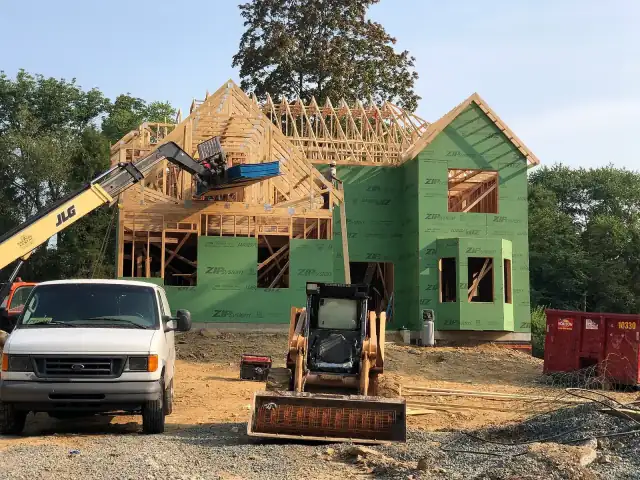
Assessors must adjust assessments every year for any property that has had “a material physical change” (RSA 75:8). They find new houses through building permits. Portsmouth’s assessing manual spells out the method most towns follow: a building under construction on April 1 gets an “under construction” status and a percent complete “as of April 1,” and the flag stays on so staff check it again the next year (City of Portsmouth Residential Data Collection Manual). Nashua’s revaluation guidelines say the same thing: “Percent complete is as of April 1st of the given year” (City of Nashua).
There is no mid-year proration for a house that gets finished in, say, August. The only proration in the statute covers buildings damaged by fire or natural disaster (RSA 76:21). That cuts both ways. A house finished on April 2 goes a whole year taxed at its April 1 stage. A house finished on March 30 is taxed in full that tax year.
A worked timeline
Say you buy a Littleton lot the town values at $100,000 and build a house the town will eventually value at $500,000. Using Littleton’s 2026 rate of $15.52:
| April 1 status | Assessed value | Annual tax at $15.52 |
|---|---|---|
| Land only, nothing started | $100,000 | $1,552 |
| House 60% complete (framed, roofed, windows in, no finishes) | $100,000 + 60% of $500,000 = $400,000 | $6,208 |
| House finished | $600,000 | $9,312 |
Rate source: NH DRA, 2026 Municipal Tax Rates. Values are an illustration; percent complete is the assessor’s judgment.
A house started after mud season usually reaches the next April 1 partly done and the following April 1 finished, so the full bill lands in the second tax year. Our post on how long it takes to build a house in New Hampshire covers typical schedules.
Which bill shows the new value
Many towns bill twice a year under RSA 76:15-a. The first bill, due July 1, is figured as half of last year’s tax rate times last year’s assessed value, so it usually doesn’t include the new house yet. The statute does let selectmen use the current year’s appraisal for that first bill when a property has “physically changed in valuation.” The rest of the year’s tax is due on the second bill, typically December 1, after the state approves the new rate. That December bill is where most owners of new houses see the jump.
Unpaid taxes draw interest at 8 percent a year (RSA 76:13). If your lender escrows taxes based on the land-only bill, expect an escrow shortage the year the house is picked up.
How do towns assess a new house?
By law, all taxable property is appraised at market value, meaning “full and true value” (RSA 75:1). For a brand-new house there are few sales to compare against, so assessors lean on cost. Portsmouth’s manual describes building a value from square footage times a unit cost per area type, “derived from local builders, Marshall and Swift, and the marketplace,” then adjusting for features, condition and percent complete (City of Portsmouth). An assessor will usually measure the house and may ask to see the inside.
So the assessment is not your construction cost. It is the town’s estimate of market value, at the same level it assesses everyone else, and rural appraisals of new custom homes often come in below cost (Owl’s Nest Real Estate). Finished space is what costs you: a finished basement or a bonus room over the garage adds living area on the property card, while other areas are priced at a fraction of living space. Portsmouth’s example prices a basement garage at 50 percent of living area (City of Portsmouth).
Assessors make errors in both directions. In 2025 Windham’s selectmen granted an abatement after its contracted assessor found part of a second floor had been “listed as finished” when it was not complete on April 1, 2024 (Town of Windham minutes, May 19, 2025). Ask for your property record card each year while the house is going up.
One New Hampshire owner building a large addition themselves wrote in March 2026 that assessors came out before the March 31 deadline and photographed the framed, roofed shell, even though the space was likely a year from being livable (Reddit r/newhampshire). That is how the system is meant to work: you are taxed on the percent complete, whether or not you can live in it yet.
What are the property tax rates in Littleton, Bethlehem, Franconia, Sugar Hill, Lincoln and Whitefield?
The rate is set each fall, after the town, school and county budgets are known, and approved by the NH Department of Revenue Administration (DRA). As of November 18, 2026, the DRA’s completed-rates list includes Littleton’s 2026 rate but not the other five towns’, so their latest rates are from 2025.
| Town | Latest total rate (per $1,000) | Year | Municipal | County | State ed. | Local ed. |
|---|---|---|---|---|---|---|
| Littleton | $15.52 | 2026 | $3.95 | $1.34 | $1.01 | $9.22 |
| Littleton | $14.10 | 2025 | $3.37 | $1.19 | $1.01 | $8.53 |
| Bethlehem | $16.19 | 2025 | $4.50 | $1.18 | $1.23 | $9.28 |
| Franconia | $15.94 | 2025 | $6.74 | $1.73 | $1.60 | $5.87 |
| Sugar Hill | $11.94 | 2025 | $4.87 | $0.98 | $1.18 | $4.91 |
| Lincoln | $12.66 | 2025 | $6.63 | $1.53 | $1.66 | $2.84 |
| Whitefield | $16.21 | 2025 | $5.31 | $2.50 | $1.07 | $7.33 |
Sources: NH DRA, 2026 Municipal Tax Rates and 2025 Municipal Tax Rates. Littleton’s 2026 rate was set November 3, 2026 and is about 10 percent higher than 2025, which the town says adds nearly $600 to the average home’s bill (The Notch, November 16, 2026).
The other towns’ 2026 rates should be set by late December. Check the DRA’s tax rate page or call the town office before you budget. Some properties also sit in a village district with its own added rate; in Bethlehem, for example, the 2025 total inside the Bethlehem Village District was $16.67 (Owl’s Nest Real Estate).
Why the lowest rate isn’t always the lowest bill
Towns don’t all assess at full market value between revaluations. Each year the DRA compares assessments with actual sale prices and publishes a median ratio. A ratio of 60 percent means the town’s assessments average 60 percent of what houses sell for. Multiply the rate by the ratio and you get a rough effective rate on market value:
| Town | Total rate | 2025 median ratio | Effective rate on market value |
|---|---|---|---|
| Littleton (2026 rate) | $15.52 | 97.9% | about $15.19 |
| Bethlehem | $16.19 | 76.4% | about $12.37 |
| Franconia | $15.94 | 60.7% | about $9.68 |
| Sugar Hill | $11.94 | 98.8% | about $11.80 |
| Lincoln | $12.66 | 63.2% | about $8.00 |
| Whitefield | $16.21 | 95.5% | about $15.48 |
Ratios: NH DRA, 2025 Median Ratio Report. The effective rate is our calculation (rate × ratio), not a DRA figure.
Low ratios don’t last. Each town must review its assessments on a five-year cycle, and the DRA’s schedule lists 2026 as the review year for both Franconia and Lincoln (NH DRA, 2023-2027 Assessment Review Cycle). Lincoln moved its assessing software in September 2026 as part of its revaluation (CivicIQ, from Lincoln Select Board minutes of September 14, 2026). After a revaluation, assessments rise toward market value and the rate drops. One poster on r/newhampshire described exactly that: assessments went from about 63 percent to 99 percent of market, the rate fell, and most bills still rose about 20 percent (Reddit r/newhampshire, January 2025). For budgeting, use the effective rate, not the posted one.
What will the tax bill be on a $600,000 or $900,000 new house?
Here are two ways to estimate it. “At full value” assumes the town assesses your house and land at exactly those amounts. “At the town’s 2025 ratio” assumes the assessor values your new house at the same level as everything else in town, which is what the law requires.
| Town | $600,000 at full value | $600,000 at town’s ratio | $900,000 at full value | $900,000 at town’s ratio |
|---|---|---|---|---|
| Littleton (2026 rate) | $9,312 | $9,116 | $13,968 | $13,675 |
| Bethlehem | $9,714 | $7,421 | $14,571 | $11,132 |
| Franconia | $9,564 | $5,805 | $14,346 | $8,708 |
| Sugar Hill | $7,164 | $7,078 | $10,746 | $10,617 |
| Lincoln | $7,596 | $4,801 | $11,394 | $7,201 |
| Whitefield | $9,726 | $9,288 | $14,589 | $13,932 |
Rates and ratios from the tables above; all except Littleton use 2025 rates. The math: $600,000 ÷ 1,000 × $15.52 = $9,312.
Read the right-hand columns as the better guide in Bethlehem, Franconia and Lincoln, and expect Franconia’s and Lincoln’s posted rates to fall after their 2026 revaluations. Rates also change every year with budgets, as Littleton’s 10 percent jump shows. These are planning numbers, not quotes from the town. If you’re still pricing the house itself, our cost to build a house in New Hampshire guide has the per-square-foot numbers.
What happens if your land is in current use?
A lot of rural land in Grafton and Coos counties is enrolled in current use, which taxes it at a low rate while it stays open. Building ends that for the land you develop.
The land use change tax is 10 percent of the land’s full and true value, ignoring the current use value and any equalization factor (RSA 79-A:7, I). The land is valued on the date the use changes, not April 1, and the tax is due when the change happens. Work like a driveway, excavation or site prep triggers it, as our land-buying guide explains. The owner at the time of the change pays, so if you buy current use land and build, the bill is yours (RSA 79-A:7, II). The town has 18 months after it gets written notice of the change, or discovers it, to mail the bill.
It can come up at the permit stage. Franconia’s driveway permit application asks whether the lot is in current use and how many square feet will come out, and states that “a change-of-use tax will be levied” (Town of Franconia driveway permit application).
Example: if the town values the acre and a half you clear for the house, driveway, septic and yard at $50,000, the land use change tax is $5,000. Only the changed acreage is taxed as long as the rest still qualifies. Our guide to buying land to build a house in New Hampshire covers how to check current use status before you buy.
Are there veterans, elderly or solar exemptions?
Yes, but each has residency and filing rules, and most are set or adopted town by town.
| Break | What the statute says | Who qualifies |
|---|---|---|
| Standard veterans’ credit | $50 off the tax bill (RSA 72:28) | NH resident veterans with qualifying wartime service, or spouses |
| Optional veterans’ credit | Town may adopt $51 to $750; the cap rises to $1,000 on April 1, 2027 (RSA 72:28) | Same; replaces the $50 credit |
| All veterans’ credit | Same amount as the town’s veterans’ credit, if adopted (RSA 72:28-b) | NH resident veterans with 90 days’ active service who don’t get the other credit |
| Elderly exemption | Town sets amounts for ages 65 to 74, 75 to 79 and 80+, at least $5,000 off assessed value (RSA 72:39-b) | NH resident 3+ years, under town income and asset limits (state floors: $13,400 single, $20,400 married, $35,000 assets excluding the home) (RSA 72:39-a) |
| Solar exemption | Town may exempt the value of a solar energy system (RSA 72:62) | Any owner, where adopted |
The application deadline for most credits and exemptions is April 15 before the rate is set, on the DRA’s permanent application form, and you must have qualified on April 1 (RSA 72:33). If you move into a new house you built, file an amended application by December 1 after the move.
The veterans’ credits are subtracted from tax on “the veteran’s residential property,” and the elderly exemption requires New Hampshire residency, so a second home owned by out-of-state residents generally won’t qualify. If you’re putting solar on a new house, ask the assessor whether the town has adopted the solar exemption before you finalize the design.
How do you appeal a property tax assessment in New Hampshire?
The process has hard deadlines, and missing one ends the appeal.
- Get the property record card. Check square footage, finished areas, bathrooms, percent complete and land size against what’s actually there on April 1.
- Talk to the assessor. Many errors on new houses, like a level listed as finished too early, get fixed informally.
- File a written abatement application with the selectmen or assessors by March 1 following the date of the final tax bill (RSA 76:16). Use the form prescribed by the Board of Tax and Land Appeals (BTLA), state your reasons specifically, and list comparable properties. You must also have filed any inventory form your town requires under RSA 74.
- The town has until July 1 to decide. No answer counts as a denial (RSA 76:16, II).
- Appeal by September 1 to the BTLA (filing fee $65) or to superior court. The BTLA offers a small-claims track (RSA 76:16-a).
- Keep paying the bill while you appeal. Unpaid tax draws 8 percent interest regardless, and if you win, the abatement is refunded with interest (RSA 76:16, III).
The final bill is the second bill in towns that bill twice a year (RSA 76:1-a). For a 2026 bill mailed in November, the abatement request is due March 1, 2027. A land use change tax bill has its own clock, which starts when that bill is mailed.
Have a reason beyond “the bill is too high.” Abatements are granted for wrong facts on the card, for being assessed out of line with comparable properties in town, or for a percent complete that overstated the work on April 1. A house that cost more than its assessment is not a reason, and neither is a town-wide rate increase.
What should you do before and during the build?
- Pull the lot’s property card and tax bill before you buy. Check current use status, the land value, and whether the lot is in a village district.
- Budget taxes from the effective rate, not the posted one, in towns with low ratios or a revaluation coming.
- Plan the land use change tax into the site budget if the land is in current use.
- Tell your lender the tax escrow will rise once the house is picked up.
- Keep dated photos of the house around April 1 each year during construction. They’re your evidence if percent complete is overstated.
- Review the assessment notice each year and file by March 1 if it’s wrong.
- File exemption applications by April 15 once you live there, if you qualify.
If you’re planning a house in Littleton, Bethlehem, Franconia, Sugar Hill or nearby, we can help you think through the site, the schedule and what the finished house will cost to own. Start on our custom homes page or get in touch.
Sources
- NH General Court: RSA 76:2, Property Tax Year (accessed November 2026)
- NH General Court: RSA Chapter 76, Apportionment, Assessment and Abatement of Taxes (incl. 76:21) (accessed November 2026)
- NH General Court: RSA Chapter 75, Appraisal of Taxable Property (75:1, 75:8) (accessed November 2026)
- NH General Court: RSA 76:15-a, Semi-Annual Collection of Taxes (accessed November 2026)
- NH General Court: RSA 76:13, Interest (accessed November 2026)
- NH General Court: RSA 76:1-a, Definitions (accessed November 2026)
- NH General Court: RSA 76:16, Abatement by Selectmen or Assessors (accessed November 2026)
- NH General Court: RSA 76:16-a, Appeal to Board of Tax and Land Appeals (accessed November 2026)
- NH General Court: RSA 79-A:7, Land Use Change Tax (accessed November 2026)
- NH General Court: RSA 72:28, Standard and Optional Veterans’ Tax Credit (accessed November 2026)
- NH General Court: RSA 72:28-b, All Veterans’ Tax Credit (accessed November 2026)
- NH General Court: RSA 72:33, Application for Exemption or Tax Credit (accessed November 2026)
- NH General Court: RSA 72:39-a, Conditions for Elderly Exemption (accessed November 2026)
- NH General Court: RSA 72:39-b, Elderly Exemption Amounts (accessed November 2026)
- NH General Court: RSA 72:62, Exemption for Solar Energy Systems (accessed November 2026)
- NH Department of Revenue Administration: 2026 Municipal Tax Rates (completed rates) (accessed November 2026)
- NH Department of Revenue Administration: 2025 Municipal Tax Rates (accessed November 2026)
- NH Department of Revenue Administration: Municipal and Village District Tax Rates (accessed November 2026)
- NH Department of Revenue Administration: 2025 Median Ratio Report (accessed November 2026)
- NH Department of Revenue Administration: 2023-2027 Assessment Review Cycle (accessed November 2026)
- The Notch: Littleton Property Tax Rate Rises 10 Percent for 2026 (November 16, 2026) (accessed November 2026)
- City of Portsmouth Assessor’s Office: Residential Data Collection Manual (rev. 2024) (accessed November 2026)
- City of Nashua: Data Collection Guidelines (2020) (accessed November 2026)
- Town of Windham: Board of Selectmen Minutes, May 19, 2025 (accessed November 2026)
- Town of Franconia: Driveway Permit Application (accessed November 2026)
- CivicIQ: Lincoln Transitions Tax Assessment Software From Vision (September 14, 2026) (accessed November 2026)
- Owl’s Nest Real Estate: Building a New Home in New Hampshire (2026) (accessed November 2026)
- Owl’s Nest Real Estate: Littleton NH Real Estate & Town Guide (November 2026) (accessed November 2026)
- Reddit r/newhampshire: Tax assessment question (March 2026, homeowner anecdote) (accessed November 2026)
- Reddit r/newhampshire: Reassessment / prop tax (January 2025, homeowner anecdote) (accessed November 2026)