Building a custom house in New Hampshire usually takes 12 to 18 months from buying the land to moving in, with 8 to 12 months of that in construction, according to a broker who works in Grafton, Belknap and Carroll counties (Owl’s Nest Real Estate). Federal data says the same thing from another angle: contractor-built houses finished in the Northeast in 2025 averaged 1.5 months from permit to start and 13.8 months from start to completion (US Census Bureau). In the North Country, the calendar matters as much as the crew. Frost, spring road postings and a short season decide when the foundation can go in, and everything else follows from that date.
How long does it take to build a house, according to the Census Bureau?
The Census Bureau’s Survey of Construction tracks how long new houses take. It reports four regions, not states, so New Hampshire falls under the Northeast. It also splits houses by who builds them. “Contractor-built” means an owner hired a builder to put a house on the owner’s land, which is what most custom homes are. “Owner-built” means the owner acted as the builder.
Average months for single-family houses completed in 2025 (Census, length of time tables):
| Measure | Northeast, contractor-built | Northeast, owner-built | Northeast, built for sale | US, contractor-built |
|---|---|---|---|---|
| Permit to start of construction | 1.5 | 2.5 | 1.3 | 1.4 |
| Start to completion | 13.8 | 14.5 | 9.9 | 10.5 |
| Permit to completion (sum) | 15.3 | 17.0 | 11.2 | 11.9 |
| Share taking 13+ months from start to completion | 38% | 47% | 22% | 26% |
The last row comes from the Census distribution table for the same year (Census, months from start to completion, 2025). The sums are ours.
The Northeast is the slowest region. The NAHB’s analysis of the same survey found New England had the longest average time from permit to completion of any division in 2025, 13.5 months for all single-family houses, against 8.8 months nationally (NAHB Eye on Housing). It is also getting slower while the country gets faster: the Northeast contractor-built average rose from 12.4 months in 2024 to 13.8 in 2025, while the US figure eased from 10.6 to 10.5 (Census).
Custom work takes longer than spec homes. Builders of houses for sale repeat a few plans with the same crews, while a custom house on your land is a one-off.
The regional numbers show a pattern, and any one house can land well off it. They are survey estimates: the Census puts the relative standard error at 7 percent for the Northeast contractor-built completion time and 21 percent for its permit-to-start time. The Census clock also starts at the permit. Design, the survey, septic approval and financing all happen before that and are not counted.
How long does each phase of building a custom home take in NH?
Here is a typical sequence for a custom house on a rural lot with a well and septic. Some steps overlap. The durations come from builders, installers and the statutes; your own house will have its own schedule.
Before the excavator shows up
| Phase | Typical time | Source |
|---|---|---|
| Boundary and site survey | 2 to 4 weeks | Attitash Home Builders |
| Septic designer: test pits, soils, plan | 1 to 3 weeks to schedule and complete | O’Connor Landworks |
| House design and engineering | 3 to 5 weeks for a set of plans; 3 to 6 months for full custom design and permitting | Attitash; Black Mountain Design Build |
| NHDES septic approval | 15 working days by law after a complete application; 2 to 8 weeks reported in practice | RSA 485-A:31; O’Connor Landworks |
| Driveway permit onto a state road | Decision within 60 days of a complete application | RSA 236:13, IV-a |
| Town building permit | Decision within 30 days of a complete application | RSA 155-A:4, IX |
| Construction loan closing | About 60 days once the builder, plans and specs are set (one lender’s figure) | St. Mary’s Bank |
A few of these can’t run in parallel. Bethlehem’s application asks for the state “Septic Approval for Construction” number, so the town permit comes after NHDES (Town of Bethlehem; our permits guide walks through the order). Some towns also review the septic design before it goes to the state; Franconia’s building checklist says the town needs to see it first (Franconia checklist, v. 10.07.2017). And the 15-day NHDES clock restarts if the department asks for more information: it then has 15 working days from receipt of everything it asked for (RSA 485-A:31). A lot near a lake or wetland adds a shoreland or wetlands permit on top.
Add it up and the paperwork alone is commonly two to six months before anyone digs. One Seacoast design-build firm budgets six months or more for design and pre-construction (Oxland Builders).
Construction
| Phase | Typical time | Source |
|---|---|---|
| Clearing, excavation, footings, foundation, backfill | 1 to 2 months | Oxland Builders |
| Framing: floors, walls, roof structure | 1 to 2 months | Oxland Builders |
| Dry-in: roofing, windows, exterior doors, wrap | 3 to 5 weeks | NHRealEstate.com |
| Plumbing, electrical and HVAC rough-ins, inspections | 6 to 8 weeks | Oxland Builders |
| Insulation, drywall, trim, start of interior finishes | 2 to 3 months | Oxland Builders |
| Flooring, fixtures, final touches | 1 to 2 months | Oxland Builders |
| Septic install and NHDES inspection | 2 to 5 days on site; NHDES must inspect within 7 business days of notice | O’Connor Landworks; RSA 485-A:29 |
| Final inspections, punch list, certificate of occupancy | 1 to 3 weeks | NHRealEstate.com |
The math: 1 to 2 months for the foundation, 1 to 2 for framing, about 1 for dry-in, 1.5 to 2 for rough-ins, 2 to 3 for drywall and trim, 1 to 2 for finishes and about half a month for finals comes to roughly 8 to 12.5 months. That lines up with Oxland’s 7 to 12 months and the Grafton-area broker’s 8 to 12 (Oxland, Owl’s Nest). It is shorter than the Census Northeast average of 13.8 months, which includes every slow job in the region.
Not every town issues a certificate of occupancy. State law lets towns with an enforcement ordinance require one (RSA 155-A:3), and wherever you build, the septic system needs its NHDES Approval for Operation before anyone uses it (NHDES).
How do the seasons affect a build in northern New Hampshire?
Up here the schedule is set by three dates: when the frost leaves the ground, when the spring road postings come off, and when winter returns.
Frost depth and the foundation
Footings must go below the frost line, and up here that is deep. Bethlehem’s single-family permit application lists a required frost depth of 60 inches, plus a 105 psf snow load at 1,800 feet (Town of Bethlehem). A Vermont design-build firm writes that foundation work there waits until frost is out of the ground, usually in May (Black Mountain Design Build). Winter pours are possible with heat, blankets and accelerators, but they cost more. Our guide to building a house in winter covers what it takes.
Mud season road postings
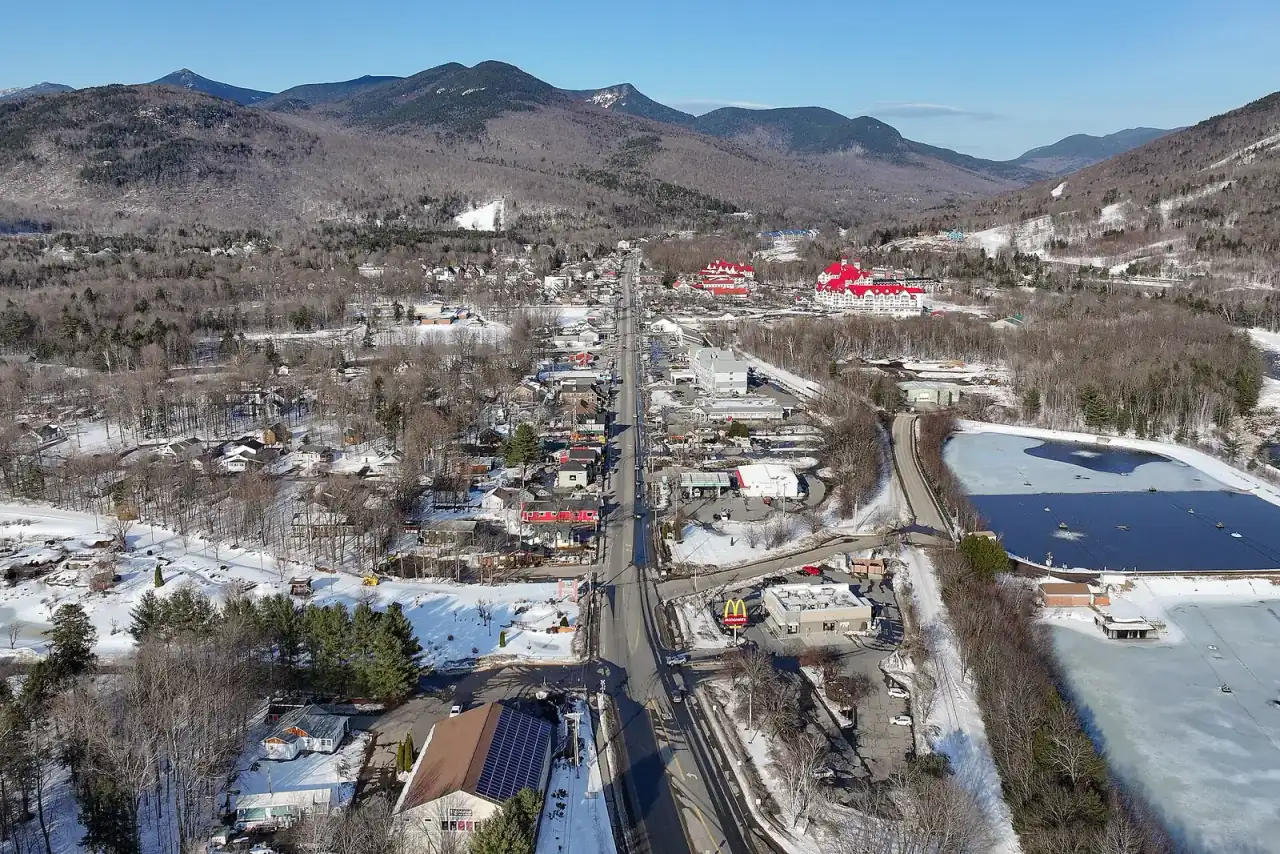
When the frost comes out in March and April, roads get posted against heavy trucks. On posted state highways the limit is 30,000 pounds gross (NHDOT). In 2026 NHDOT ordered postings on March 9 (NHDOT), and Lincoln posted a 6-ton limit on town roads on March 13 (Town of Lincoln). For scale, one ready-mix supplier lists its loaded 10-yard mixer at 72,000 pounds (Salmon Bay Sand & Gravel), more than twice the state limit and six times a 6-ton town limit. If your lot is on a posted gravel road, nothing heavy moves until the town lifts the posting, and there is no fixed date for that.
The short season
Work backward from the first hard freeze. The goal for most North Country builds is a foundation in early summer and the house closed in (roof on, windows and doors in) by late fall. After that, insulation, drywall and finishes go on through the winter under heat. A house that misses that window pays for winter protection or waits for spring. One New Hampshire real estate site estimates that winter weather can add 4 to 8 weeks to a schedule (NHRealEstate.com).
A realistic North Country calendar
Laid out on a calendar, the phase times above might look like this for a typical lot:
| When | What happens |
|---|---|
| Summer to fall, year 1 | Land under contract, survey, test pits and septic design while the ground is open; pick a builder; start design |
| Late fall to winter | Final plans and engineering, NHDES septic approval, driveway permit, town permit, loan application, selections; order windows |
| Late winter to spring | Loan closes; wait for postings to lift |
| May to June, year 2 | Clearing, excavation, foundation, backfill |
| July to August | Framing |
| September to October | Roof, windows, doors, siding; rough-ins; septic install |
| November to February | Insulation, drywall, trim, cabinets, flooring under heat |
| March to April, year 3 | Finals and move-in, often just as the next mud season starts |
| Following summer | Final paving, loam and seed, landscaping |
From first design meeting to keys, that is about 18 months. Start design a few months late and the foundation can slip a full year, because the window between road postings and hard frost doesn’t move.
What causes the most delays when building a house in New Hampshire?
Septic redesigns and extra permits
If the test pits show ledge, high groundwater or poor soils, the design changes, and every NHDES request for more information restarts its 15-day clock (RSA 485-A:31). One Lakes Region installer says state review runs slower in summer, when shoreland reviews pile up (O’Connor Landworks). A lot near water or wetlands adds its own state permit. We tell clients to get the septic design started before they close on the land; our site costs guide explains why.
Ledge
Granite under the foundation hole means hammering or blasting, which adds days or weeks and a separate contractor. You often don’t know until you dig. A builder in Lincoln advises budgeting for blasting, which it calls common in the White Mountains (We Build NH).
Finding a builder and trades
Labor is tight. In September 2026, 47 percent of builders nationally reported shortages across nine core trades, higher than at any point in the 2004 to 2006 boom. Framing crews were short for 57 percent of builders and finish carpenters for 58 percent (NAHB Eye on Housing). In rural areas a good builder is often booked a season or more ahead, so the wait for a start date can be longer than the build. Our guide to choosing a builder covers how to vet one.
Late selections and change orders
Every decision left until framing is a chance to stall the job. A Lincoln builder’s checklist says to finalize all selections before framing and to order windows and doors right after design, because New Hampshire lead times run 8 to 14 weeks (We Build NH).
Power
Utilities won’t design a new service until the site is real. New Hampshire Electric Cooperative’s terms, approved October 27, 2026, require an approved septic plan, a site plan, a roughed-in driveway, the closest pole number and a foundation or other evidence you will finish within 12 months before it builds a new service, and you must secure any easements the line needs; if the easements or site work aren’t done within 12 months, the project is cancelled (NHEC). Long runs through woods need tree clearing and sometimes easements from neighbors. Call the utility that serves your lot early.
The loan
Lenders want final plans, a builder contract and a budget before they close, and they release money only after inspections. If the appraisal comes in low, the loan gets resized and the start slips. See our construction loan guide for how draws and appraisals work.
Being your own general contractor
Owner-built houses in the Northeast averaged 2.5 months from permit to start and 14.5 months to finish in 2025, slower on both counts than contractor-built houses (Census). Lining up subs is a full-time job.
What do New Hampshire and Vermont owners report about build times?
These are individual reports from Reddit threads. They show what people ran into, though they are not data.
- In 2025, an owner planning a near tear-down of a New Hampshire lake camp said they started planning in 2023 and picked a GC two years before breaking ground. Town setback and height variances came in September 2024, NHDES approval the following spring, the town permit in September 2025 and financing in October. They broke ground two weeks after that (r/Remodel, November 2025).
- Also in 2025, someone working for a high-end custom builder in Vermont reported 7 to 10 months from breaking ground to move-in, with their firm and others they know booked 2 to 3 years out. They advised being wary of a builder who can start right away (r/vermont, March 2025).
- In the same thread, a Vermont timber frame owner who bought a lot with septic engineering and permits done in 2015 broke ground in October 2019 and moved in in September 2020. The timber frame and SIP shell was closed in within two weeks of the crew arriving; interior finish took most of the year.
- Another commenter put it as 6 to 9 months with a ready lot and paperwork, and 12 to 18 months when buying land without them.
- A Vermont owner in 2022 found their builder booked more than a year out, with site work planned for 2023 and the house to start at the end of that year (r/vermont, July 2022). In the same thread, they described an acquaintance acting as his own GC who had been in a rental for 30 months on a house planned for 18 to 20.
These stories match the data: construction is the predictable part, and land, approvals, the builder’s calendar and financing set the start date.
How can you shorten a build in New Hampshire?
- Start the septic design first. It decides where the house goes, and the town permit waits on it.
- Use the winter for paperwork. Design, permits, the loan and selections can all be done while the ground is frozen.
- Make every selection before you sign. Windows, cabinets, flooring and fixtures chosen up front can be ordered early.
- Keep the design simple. Fewer roof planes and corners frame and dry in faster.
- Line up power and the driveway early. The utility and the road agent run on their own calendars.
- Consider a factory-built shell. Modular and panelized houses spend far less time open to the weather. One Vermont owner reported a modular house set by crane in mid-November and lived in two and a half months later (r/vermont). See modular vs. stick-built for the tradeoffs.
Is building worth the wait, or should you buy?
If you need a house within a year, buying is usually faster and often cheaper; our cost guide runs the numbers. Building makes sense when you already have the land, nothing on the market fits, and you can carry rent or a current mortgage through a 12- to 18-month process. If you are planning a custom home around Littleton, Bethlehem, Franconia or Sugar Hill, Fregeau Builders can walk your lot and lay out a realistic calendar for it. Get in touch in the fall and the paperwork can be done by the time the roads open.
Sources
- US Census Bureau: New Residential Construction, Length of Time tables (average months, authorization to start and start to completion, 2025) (accessed November 2026)
- US Census Bureau: Number of Housing Units Completed by Number of Months from Start, 2025 (accessed November 2026)
- NAHB Eye on Housing: Single-Family Home Construction Time Declines in 2025 (Sept. 8, 2026) (accessed November 2026)
- Owl’s Nest Real Estate: Building a New Home in New Hampshire (updated Nov. 12, 2026) (accessed November 2026)
- Oxland Builders: How Long Does It Take to Build a Custom Home in New Hampshire? (Feb. 3, 2025) (accessed November 2026)
- We Build NH: Guide 04, Custom Home Build Timeline (accessed November 2026)
- NHRealEstate.com: Cost to Build a Home in New Hampshire (Jan. 2, 2026) (accessed November 2026)
- Attitash Home Builders: Frequently Asked Questions (accessed November 2026)
- Black Mountain Design Build: What to Expect During Custom Home Construction in Putney (Oct. 15, 2026) (accessed November 2026)
- O’Connor Landworks: NH Septic Install Cost, Timeline and Process (Apr. 18, 2026) (accessed November 2026)
- NH General Court: RSA 485-A:31, Action on Applications (accessed November 2026)
- NH General Court: RSA 485-A:29, Submission and Approval of Plans and Specifications (accessed November 2026)
- NH General Court: RSA 236:13, Driveways and Other Accesses to the Public Way (accessed November 2026)
- NH General Court: RSA 155-A:4, Permit Required (accessed November 2026)
- NH General Court: RSA 155-A:3, Building Code Enforcement (accessed November 2026)
- NHDES: Septic Systems (accessed November 2026)
- Town of Bethlehem: New Single-Family Construction Building Permit Application (accessed November 2026)
- Town of Franconia: Building Permit Checklist (v. 10.07.2017) (accessed November 2026)
- Salmon Bay Sand & Gravel: Truck Specifications (accessed November 2026)
- NHDOT: Weight Restrictions, Spring Postings (accessed November 2026)
- NHDOT: Annual Road Postings Underway on Sections of State Highways (Mar. 9, 2026) (accessed November 2026)
- Town of Lincoln: 2026 Spring Road Bans, 6-Ton Limit Posted March 13, 2026 (accessed November 2026)
- NAHB Eye on Housing: Labor Shortages a Growing Problem (Oct. 14, 2026) (accessed November 2026)
- New Hampshire Electric Cooperative: Terms and Conditions (approved Oct. 27, 2026) (accessed November 2026)
- St. Mary’s Bank: Construction-to-Permanent Mortgage Loans (accessed November 2026)
- Reddit r/Remodel: Over 2 years of planning and finally broke ground… in NH (Nov. 2025) (accessed November 2026)
- Reddit r/vermont: How long did building a house take you in the current market? (Mar. 2025) (accessed November 2026)
- Reddit r/vermont: How Much Does it Cost to Build a House in Vermont? (July 2022, updated 2023) (accessed November 2026)