
Yes, in most cases, but the road changes who pays for almost everything. Since July 1, 2026, a New Hampshire town must issue a building permit for a lot on a Class VI road if the owner signs a liability waiver, records it at the county registry of deeds and proves the lot and any buildings are insurable, all before the permit is issued (RSA 674:41, I(c)). A private road still needs the selectboard to vote to authorize permits. Neither route gets around zoning frontage rules, and on both the town owes you no plowing, grading or other services. Lenders and insurers then look at the road on their own terms.
Our land buying guide has the short version, along with the septic, current use and survey checks every lot needs.
What are Class V, Class VI and private roads?
New Hampshire sorts public highways into seven classes (RSA 229:5). Three matter for a house lot in a rural town:
| Type | Legal definition | Who has to maintain it |
|---|---|---|
| Class V (town road) | “All other traveled highways which the town has the duty to maintain regularly” (RSA 229:5, VI) | The town |
| Class VI | All other existing public ways, including roads discontinued subject to gates and bars and roads the town hasn’t maintained in suitable condition for travel for 5 successive years or more (RSA 229:5, VII) | No one. Towns have no duty of care for construction, maintenance or repair (RSA 231:93) |
| Private road | Not defined in statute. NH Municipal Association lawyers describe it as a way the town has no duty to maintain, which may or may not carry public rights (NHMA, Oct. 2025) | The owners who use it (RSA 231:81-a) |
A Class VI road is still a public highway. NHMA’s lawyers describe Class VI roads as full public highways in every respect except maintenance (NHMA). Anyone can drive them, the town keeps the same regulatory power it has over Class V roads, and a driveway onto one still needs a town permit (RSA 231:21-a, II).
How common they are varies. Lisbon counts 7.3 miles of Class VI road against 39.6 miles of Class V (Lisbon Master Plan, Transportation). Franconia has 0.87 miles of Class VI and 26.56 of Class V, and the upper part of Wallace Hill Road is Class VI (Franconia Master Plan 2024).
Class V vs Class VI vs private road: permit, maintenance, plowing, lending
| Class V | Class VI | Private road | |
|---|---|---|---|
| Building permit under RSA 674:41 | Allowed (I(a)) | Allowed since July 1, 2026 with a recorded waiver and proof of insurability (I(c)) | Only if the selectboard votes to authorize permits, after planning board review or under an adopted policy, plus a recorded notice (I(d)) |
| Zoning frontage | Counts | Counts only if the ordinance’s wording allows; otherwise a variance | Usually counts only if the planning board approved the road; otherwise a variance |
| Maintenance and repair | Town’s duty (RSA 229:5, VI) | No municipal duty (RSA 231:93); owners do it with a town permit for work in the road | Owners share the cost (RSA 231:81-a) |
| Plowing | Town | Owner’s contractor | Owners or road association |
| Public right to travel | Yes | Yes; gates must open (RSA 231:21-a) | Depends on deeds and history |
| Fannie Mae view | The standard: a “publicly dedicated and maintained street” | Must be “readily accessible by roads that meet local standards”; appraiser comments on an atypical street | Recorded maintenance agreement, or a state statute that covers it (B4-1.3-04) |
| FHA view | Meets the rule | Fits neither category cleanly; ask the lender | Permanent recorded easement; no maintenance agreement required |
Sources: RSA 674:41; RSA 229:5; RSA 231:93; RSA 231:21-a; RSA 231:81-a; NHMA; Fannie Mae B2-3-01 and B4-1.3-04; HUD 4000.1 II.A.3.a.
What changed for Class VI roads on July 1, 2026?
Before July 2026, a permit on a Class VI road needed a vote of the selectboard after planning board review, and towns had no criteria to follow. One New Hampshire real estate attorney reported one town that capped distance from a Class V road at 300 feet, another at 600, and one that had never issued a Class VI permit and didn’t plan to start (Alfano Law, July 2026).
Senate Bill 281 (Chapter 256, Laws of 2025) repealed and rewrote RSA 674:41, I(c). It was approved July 15, 2025 and took effect July 1, 2026 (SB 281 final text). The selectboard vote is gone. NHMA, which opposed the change, wrote in early 2026 that the new law “mandates” the permit once the conditions are met (NHMA, Jan./Feb. 2026).
A repeal bill, HB 1098, would have restored the selectboard vote. The House Housing Committee voted 17-0 to recommend killing it, the House tabled it on February 5, 2026, and it died on the table when the session ended August 19, 2026 (NH General Court, HB 1098). A separate 2026 law, Chapter 318 (HB 244), touched RSA 674:41 only to remove references to a “board of appeals” in paragraph II and the word “code” in paragraph III (HB 244 text).
Getting a building permit on a Class VI road, step by step
- Confirm the road’s class in writing with the selectboard office or road agent. A road that looks maintained may be Class VI, and one that looks abandoned may still be Class V.
- Read the zoning frontage rule. If it requires frontage on a Class V or better road, apply to the zoning board for a variance first (more on this below).
- Get the other approvals. The state septic approval, the town driveway permit and any shoreland or wetlands permits come before the building permit, the same as on any lot. Our building permits guide covers the order.
- Sign the town’s waiver. The statute requires you to acknowledge that the town will not maintain the road or provide any services to lots it serves, accepts no responsibility for losses caused by the lack of services, and that those services fall solely on you (RSA 674:41, I(c)(1)). NHMA recommends that selectboards prepare a standard form (NHMA guide, Aug. 2025).
- Record the waiver at the county registry of deeds (Grafton County for Littleton-area towns) and bring the town evidence of recording. A recorded waiver binds every later owner (NHMA).
- Prove insurability, also before the permit is issued (RSA 674:41, I(c)(3)).
- Get written permission before working in the road. Digging, grading or adding culverts in any town highway, Class VI included, needs written permission from the selectboard or road agent (RSA 236:9; RSA 231:21-a, II).
How do you prove the lot is insurable?
The statute doesn’t define it. The state Office of Planning and Development wrote in October 2025 that it isn’t clear whether an owner could self-insure or whether a certificate from an insurance company is required (OPD, 2025 changes). Towns are filling the gap themselves. Grantham’s March 2026 policy asks for an insurance offer letter for all-risk coverage, including fire, theft and liability at actual cash value, with general liability of at least $300,000 aggregate, from an insurer licensed by the NH Insurance Department. After occupancy the owner must show the policy is in force, or the certificate of occupancy can be revoked (Grantham Class VI Road Policy, March 2026).
Insurers can price the risk but not refuse on location alone. The NH Insurance Department said in February 2025 that state law bars insurers from denying or non-renewing homeowners coverage solely because of location, while letting them weigh factors such as distance from fire services (NHID). Expect a higher premium on a long unplowed road far from a station. The one attorney report we found is mild: a client’s insurer had no concerns (Alfano Law).
Can the town still add conditions?
Nobody knows for sure yet. The new I(c) gives the selectboard no vote, but some towns kept written Class VI policies in place. Barrington’s policy, updated for July 1, 2026, sorts permits into three categories. A new house falls in the strictest one, which calls for a road maintenance agreement, Planning Board review, a Select Board hearing, and road improvements on substandard roads: either a 16-foot gravel road with 2-foot shoulders built to carry a fire engine all year, or spending at least 10 percent of construction cost on the road (Barrington policy). On a $350,000 house, the policy’s own example puts that at $35,000. Grantham’s 2026 policy, by contrast, just restates the statute and defines the insurance proof.
We found no court decision on how far a town can go under the new language. If a town asks you for more than the waiver, the recording and proof of insurance, get a land use attorney’s view before you spend money on road work.
What did not change?
Zoning frontage
RSA 674:41 is a state access rule. Zoning is separate. NHMA’s guidance is that a town may still require frontage on a Class V or better road, but its ordinance has to say “Class V or better” clearly. If it does, a Class VI lot needs a variance. If the ordinance only says “public road,” a Class VI road qualifies and a private road doesn’t (NHMA; NHMA, Sept./Oct. 2024). One attorney says most ordinances require Class V frontage (Alfano Law). The town-by-town table below shows how local wording differs.
Subdivision didn’t change either. OPD notes that SB 281 doesn’t make a town allow a lot with frontage only on a Class VI road to be subdivided; that stays with the planning board under the zoning ordinance and subdivision regulations (OPD). The new rule helps an existing lot more than a developer hoping to carve up back land.
No maintenance, plowing or services
Towns are relieved of “all obligation to maintain” and all liability for damages on roads discontinued subject to gates and bars (RSA 231:50), and have no duty of care on any Class VI road (RSA 231:93). The recorded waiver goes further: the town provides no services to the lot at all. NHMA’s list of common waiver terms includes releasing the town from police, fire and ambulance services and making the landowner responsible for getting children to the nearest regular school bus stop (NHMA). State law requires transportation for K-8 pupils who live more than 2 miles from school, but says nothing about which roads a bus must use (RSA 189:6).
A town may choose to spend money keeping a Class VI road passable for fire and rescue equipment by declaring it an emergency lane after a public hearing. That declaration creates no duty, can be rescinded at any time without notice, and nobody may rely on it (RSA 231:59-a).
Back lots and the old appeal routes
A lot reached only by a private easement across someone else’s land still doesn’t qualify unless the easement itself meets one of the statute’s tests (RSA 674:41, III). If a permit is denied, you can still appeal to the zoning board for a “reasonable exception” on hardship grounds (paragraph II), or ask town meeting to except the lot after planning board review (paragraph II-a).
What are the rules for private roads?
RSA 674:41, I(d) lets a permit issue on a private road if the selectboard votes to authorize permits on that road, the town takes on no maintenance or liability, and a notice of those limits is recorded for your lot before the permit (RSA 674:41). Since September 13, 2025, HB 296 (Chapter 175) gives the board a second route: instead of planning board review and comment, it can find that the road “identifies and complies with policy” it has adopted (Alfano Law; NHMA). Towns don’t have to adopt one.
Where towns do write a policy, NHMA points to Pembroke’s criteria: drainage, grade, whether the surface can carry public safety vehicles, the road’s condition from the nearest Class V road to your driveway, the length of that trip, and connecting intersections (NHMA).
Without a written agreement, every residential owner who benefits from a private road must contribute equitably to the reasonable cost of maintaining it, can sue a neighbor who doesn’t, and must repair damage they cause (RSA 231:81-a). “Equitably” invites arguments. A recorded road maintenance agreement that names each lot’s share, the default remedies and a perpetual term settles it, and those are the terms Fannie Mae looks for (see the lending section).
One more exception, RSA 674:41, I(e): an existing street built before the town gave its planning board subdivision authority, shown on a plat the selectboard or zoning board approved back then, qualifies if at least one other lot on that street already has a building.
Can a Class VI road be gated?
Every Class VI road is subject to gates and bars, but a landowner’s gate can’t prevent or interfere with public use and must be capable of being opened and reclosed by anyone using the road. The selectboard can regulate gates and remove ones that interfere (RSA 231:21-a, I). NHMA reads that to mean no locks (NHMA). A town can discontinue a road subject to gates and bars by vote of the town, after which it is no longer a “publicly approved street” (RSA 231:45). The public keeps its right to travel the road, so expect other people to use it past your house.
Who pays to upgrade the road?
You do, in almost every case. Two paths lead to a Class VI road becoming a town road:
| Route | How it works | Who pays |
|---|---|---|
| Town meeting vote | A warrant article, by the selectboard or by petition, reclassifies the road as Class V on a majority vote (RSA 231:22-a) | Can be conditioned on betterment assessments to abutters; assessed costs can’t reflect standards higher than the best town road giving access to it |
| Selectboard conditional layout | On petition, the board lays out a Class V road over the Class VI road and rebuilds it to town standards (RSA 231:28) | Betterment assessments on abutters; a majority of abutting owners can block it by petition within 10 days of the hearing |
Bethlehem adds a step: a town meeting vote to accept a road or reclassify a Class VI road as Class V doesn’t take effect until the selectmen certify it meets town road construction standards (Bethlehem Zoning Ordinance, 2025).
Owners can also improve the road themselves and leave it Class VI. NHMA’s view is that a resident’s work doesn’t change the town’s lack of liability, and that towns should allow work only under a written permit supervised by the road agent (NHMA, 2023). Budget the road like a long driveway: gravel, ditching, culverts and turnouts. Our site costs guide has per-foot driveway numbers.
How do you get through winter and mud season?
Plowing is a private contract, and you need one before the first storm. Fuel dealers set their own access rules. Buxton Oil & Propane, a Dead River company in Epping, requires driveways and any private roadway cleared to at least 12 feet wide, and a driveway able to carry a fully loaded delivery truck of about 18 tons (36,000 pounds), “especially during muddy seasons,” and any bridge on the route must be rated for that weight (Buxton terms, Oct. 2026). AmeriGas’s New Hampshire terms ask for a driveway free of snow, ice and mud and sturdy enough for a loaded truck, and may charge a fee if the driver can’t get in (AmeriGas). A dealer that can’t reach the tank won’t deliver, and on a long Class VI road that can leave a house without heat in January. Heat pumps, a larger tank or a cord of wood in the shed reduce the risk.
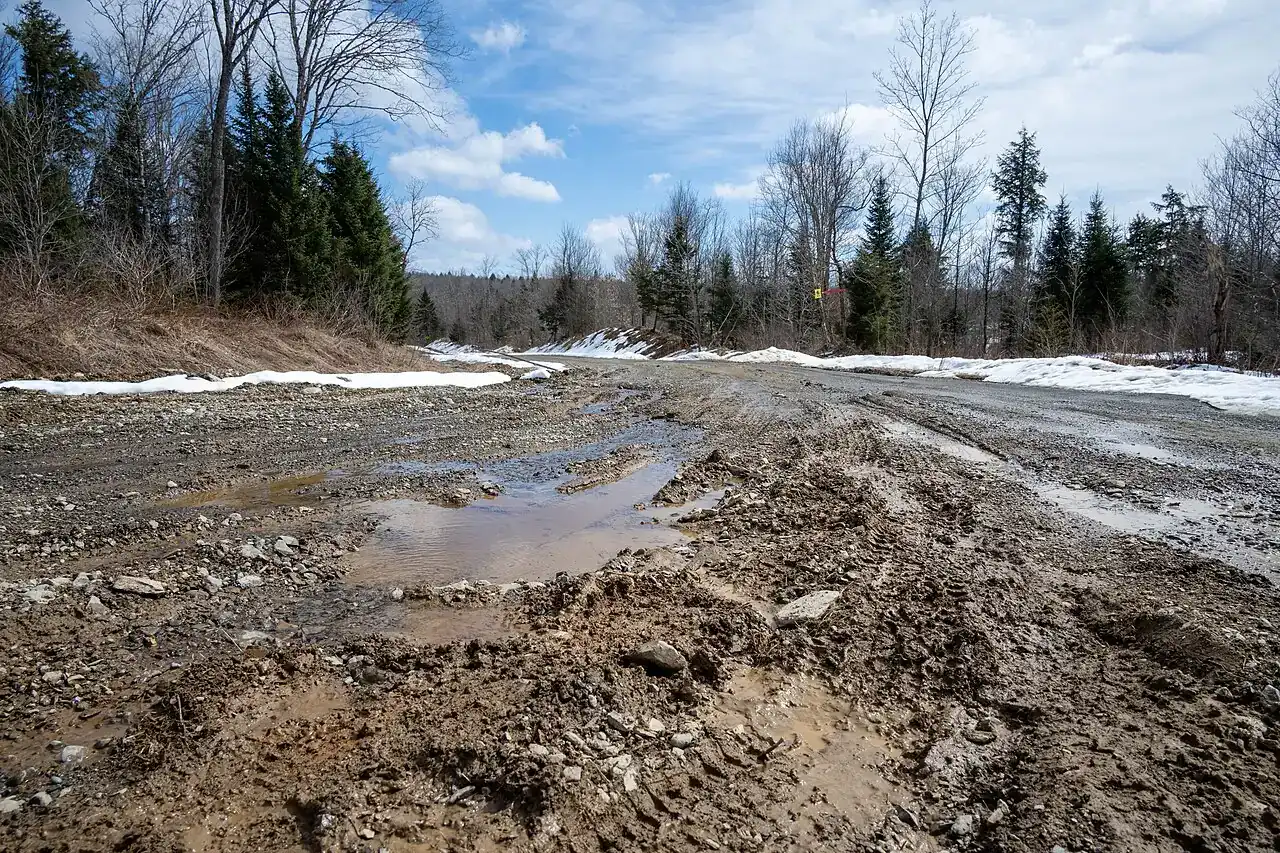
Mud season is the other limit. Towns can post seasonal weight limits on Class VI roads the same as Class V (RSA 231:21-a, II; RSA 231:191). Concrete trucks, well rigs and lumber deliveries may not get in during March and April. Schedule the foundation for after the posting comes off.
Can you get power along a Class VI road?
Usually, at your expense, and the route matters. Eversource’s tariff, effective February 1, 2026, ranks line extension routes in this order: public ways, private roads maintained year-round, private roads maintained seasonally, rights of way its equipment can reach, and rights of way it can’t. It can pick a higher-ranked route even if a lower one is shorter (Eversource NHPUC No. 11). The tariff doesn’t say where an unmaintained public Class VI road falls in that list, so ask before you buy.
| Eversource | NH Electric Co-op (NHEC) | |
|---|---|---|
| Free allowance | Transformer plus up to 300 feet | Construction allowance on the fee schedule |
| Beyond that | $43.18 per foot overhead single-phase (July 2025 to March 2026); the rate resets each April, and a 2026 update was approved April 1, 2026, so ask for the current figure | You pay the total estimated cost of any primary line, plus the cost of the service less the allowance |
| Maximum extension | 5,280 feet; longer at its discretion | Access to build and maintain the line must be “safe and feasible” |
| Easements | You provide them at no cost to the utility | You obtain them at no cost to NHEC; project cancelled after 12 months without them; new lines are cleared 15 feet each side of the primary |
| Before construction | Final placement must be preapproved by Eversource | Approved septic plan, site plan, roughed-in driveway, nearest pole number, intent to build within 12 months |
Sources: Eversource NHPUC No. 11; NHPUC Docket DE 26-002; NHEC Terms and Conditions; NHEC Handbook for Electric Service. NHEC also builds “along public ways in preference to private property routes, even if the latter may be shorter.” On private property you may hire an approved private line contractor (RSA 370:12), but Eversource doesn’t allow that along public ways.
A 1,500-foot run from the last pole on the Class V road, all overhead at the July 2025 Eversource rate, works out to (1,500 - 300) × $43.18 = $51,816, before trenching any underground service or clearing.
Will a lender finance a house on a Class VI or private road?
Some will, and the conventional rules leave room for a lender’s judgment.
- Fannie Mae won’t buy loans on properties that aren’t “readily accessible by roads that meet local standards” (B2-3-01). The appraisal guidance says a property “should front on a publicly dedicated and maintained street,” and the appraiser must address the effect of an atypical street on value (B4-1.3-04).
- For privately maintained streets, Fannie Mae wants a recorded, legally enforceable maintenance agreement covering each party’s share of repairs, default remedies and a term that binds future owners, unless the state has a statute defining owners’ maintenance duties. Without either, the lender can still sell the loan but must indemnify Fannie Mae for losses tied to the street (B4-1.3-04). New Hampshire’s statute, RSA 231:81-a, covers private roads but expressly “shall not apply to any highway defined in RSA 229:5,” which includes Class VI roads. On a Class VI road, a recorded agreement among the owners is the safer bet.
- FHA requires streets to be either dedicated to public use and maintenance or private streets protected by permanent recorded easements, and doesn’t require a maintenance agreement for private streets (HUD 4000.1 II.A.3.a). A Class VI road is public but unmaintained, so ask the underwriter early.
- Local lenders that keep loans on their own books set their own rules. Union Bank, which lends in northern New Hampshire, requires lots for its land and construction loans to have “public road frontage” along with power, water and wastewater engineering and permits (Union Bank). Ask in writing whether a Class VI road counts.
The appraisal is the other risk. Few comparable sales on unmaintained roads make value hard to support, and our construction loans guide explains why a low appraisal means more cash at closing.
Title insurance has a limit too. A standard owner’s policy insures a legal right of access, not that you can physically get there (Chicago Title, MLTA 2021). One title underwriter’s example is land at the top of a steep hill covered by ice in winter (ATG). The ALTA 17 access endorsement insures that the named street is “physically open and publicly maintained” (GRS Group), which a Class VI road is not, so don’t expect it.
What do towns around Littleton say?
We checked the posted zoning ordinances and forms for five towns in November 2026. None publishes a Class VI or private road building policy or waiver form online.
| Town | What its rules say about road access |
|---|---|
| Littleton | Frontage is the lot line bordering “a public street or a private street that has been approved by the Planning Board in a subdivision”; private roads seeking subdivision approval must meet town standards (Littleton Zoning Ordinance, amended March 2026). No Class VI form among the town’s posted forms (Forms Center) |
| Bethlehem | Minimum frontage 100 to 200 feet by district; a short-term rental permit requires access by a town or state-maintained road, or a Planning Board-approved private road that hasn’t been the subject of an RSA 674:41 waiver (Bethlehem Zoning Ordinance, 2025) |
| Franconia | New lots need the district’s street frontage (150 to 200 feet in residential districts) “along an existing street or way” (Franconia Zoning Ordinance) |
| Sugar Hill | ”Street” includes a Class VI highway “provided that the requirements of RSA 674:41, I(c) are complied with”; 200 feet of frontage in residential districts (Sugar Hill Zoning Ordinance, 2024) |
| Lisbon | Frontage must border “an approved public or improved private road that meets at least minimum state and/or local standards,” 125 feet in most districts (Lisbon Zoning Ordinance, 2023); new subdivision lots need frontage on a Class V or better road or a Planning Board-approved road (Subdivision Regulations, 2020). Its master plan recommends adopting a Class VI road policy |
Sugar Hill’s wording means a Class VI lot that meets the statute also meets the zoning definition of a street. Bethlehem’s rule matters if you plan to rent the house on weekends: a Class VI road is neither town-maintained nor a Planning Board-approved private road, so a house reached only by one doesn’t meet the short-term rental access test. Lisbon posted 2026 subdivision regulations we didn’t review, and Franconia’s posted ordinance may not be its latest, so confirm with each office.
Checklist before you buy a lot on a Class VI or private road
- Written confirmation of the road’s class from the town, and the town’s current waiver form and any written policy
- The zoning definition of frontage; if it says Class V or better, talk to the zoning administrator about a variance before you sign
- An insurance offer letter for the house you plan to build, and the proof your town will accept
- A lender’s written answer on the road, for the land loan and the construction-to-permanent loan
- Title search: how the road came to be Class VI or private, any recorded waivers, notices or maintenance agreements on the lot, and any deeded right to improve the road
- A recorded road maintenance agreement with neighbors, or a plan to sign one, naming shares, remedies and a perpetual term
- A drive of the road in March or April and after a storm, with the road agent if possible
- Spring weight postings on the road and on the Class V road that leads to it
- A road cost estimate from an excavator: width, gravel depth, culverts, ditches, turnouts, a turnaround for a fire truck
- The fire chief’s view on reaching the lot, and the distance to the station
- A utility estimate and the route, plus the easements you’d need from abutters
- A plow contractor and a fuel dealer who will commit to serving the address
- Test pits and a septic design, the same as any lot (land guide)
Mistakes that cost money
- Assuming the July 2026 law makes any Class VI lot buildable without reading the zoning ordinance.
- Buying before an insurer and a lender have looked at the road.
- Relying on a neighbor’s handshake to share plowing, with nothing recorded.
- Pricing the house and forgetting a quarter mile of road and power.
- Improving the road without the selectboard’s written permission.
- Expecting the town to take over the road once a few houses are built. It has no duty to, and an upgrade usually comes with a betterment bill.
Where to start
Get the road’s class and the zoning frontage wording from the town office, then call an insurance agent and a lender before you commit to the lot. Our step-by-step guide to building a house in New Hampshire shows where the land checks fit in the whole process. If you’re looking at a lot on a back road around Littleton, Bethlehem, Franconia, Sugar Hill or Lisbon, Fregeau Builders can walk the road and the site with you and price the road, driveway and house together as part of a custom home.
Sources
- NH General Court: RSA 674:41, Erection of Buildings on Streets; Appeals (accessed November 2026)
- NH General Court: SB 281 (2025), Chapter 256, final version (accessed November 2026)
- NH General Court: HB 1098 (2026) bill status (accessed November 2026)
- LegiScan: NH HB 244 (2026), Chapter 318, bill text (accessed November 2026)
- NH General Court: RSA 229:5, Classification (accessed November 2026)
- NH General Court: RSA 231:21-a, Uniform Provisions Governing Class VI Highways (accessed November 2026)
- NH General Court: RSA 231:22-a, Reclassifying a Class VI Highway (accessed November 2026)
- NH General Court: RSA 231:28, Conditional Layout for Existing Private Rights-of-Way or Class VI Highways (accessed November 2026)
- NH General Court: RSA 231:45, Subject to Gates and Bars (accessed November 2026)
- NH General Court: RSA 231:50, Towns Not Liable After Discontinuance (accessed November 2026)
- NH General Court: RSA 231:59-a, Emergency Lanes (accessed November 2026)
- NH General Court: RSA 231:81-a, Repair of Roads Not Maintained by a Municipality (accessed November 2026)
- NH General Court: RSA 231:93, When Municipalities Not Liable (accessed November 2026)
- NH General Court: RSA 231:191, Maximum Weight Limits (accessed November 2026)
- NH General Court: RSA 236:9, Excavation; Permit; Emergency (accessed November 2026)
- NH General Court: RSA 189:6, Transportation of Pupils (accessed November 2026)
- NH General Court: RSA 370:12, Installation of Power Line Extensions (accessed November 2026)
- NH Municipal Association: Do’s and Don’ts of Class VI and Private Roads (Oct. 15, 2025) (accessed November 2026)
- NH Municipal Association: Changes to Planning & Zoning Laws in 2025 (rev. Aug. 13, 2025) (accessed November 2026)
- NH Municipal Association: Through the Looking Glass (Again): 2026 Zoning Legislation (Jan./Feb. 2026) (accessed November 2026)
- NH Municipal Association: Subdivisions on Class VI or Private Roads (Sept./Oct. 2024) (accessed November 2026)
- NH Municipal Association: A Hybrid Hard Road to Travel (May 17, 2023) (accessed November 2026)
- NH Office of Planning and Development: 2025 Changes to Planning and Zoning Statutes (accessed November 2026)
- Alfano Law: Building Permits on Class VI and Private Roads in New Hampshire: Has the Dust Finally Settled? (July 15, 2026) (accessed November 2026)
- Town of Barrington: Class VI and Private Road Building Policy (updated for July 1, 2026) (accessed November 2026)
- Town of Grantham: Class VI Road Policy, adopted March 2026 (copy on the town’s development site) (accessed November 2026)
- NH Insurance Department: Prohibition on Location-Based Underwriting for Homeowners’ Insurance (Feb. 7, 2025) (accessed November 2026)
- Fannie Mae Selling Guide B2-3-01: General Property Eligibility (Sept. 3, 2025) (accessed November 2026)
- Fannie Mae Selling Guide B4-1.3-04: Site Section of the Appraisal Report (June 4, 2025) (accessed November 2026)
- HUD Handbook 4000.1 II.A.3.a, Property Acceptability Criteria (Nov. 10, 2026), via Zeitro (accessed November 2026)
- Union Bank: Build/Construction Loans and Land Financing (accessed November 2026)
- Chicago Title (MLTA 2021 Winter Education Series): Easements handout (accessed November 2026)
- ATG: The Nuts and Bolts of Commercial Title Insurance, Part 1 (Oct. 2, 2019) (accessed November 2026)
- GRS Group: Title Insurance 101, Covered Risk Number 4, Access (accessed November 2026)
- NHPUC: Eversource Tariff NHPUC No. 11, Electricity Delivery (effective Feb. 1, 2026) (accessed November 2026)
- NHEC: Terms and Conditions (accessed November 2026)
- Buxton Oil & Propane (Dead River Company): Terms and Conditions (updated Oct. 2026) (accessed November 2026)
- AmeriGas: New Hampshire Residential Terms and Conditions (accessed November 2026)
- Town of Littleton: Zoning Ordinance, amended March 2026 (accessed November 2026)
- Town of Littleton: Forms Center (accessed November 2026)
- Town of Bethlehem: Zoning Ordinance, amended March 11, 2025 (accessed November 2026)
- Town of Franconia: Zoning Ordinance (accessed November 2026)
- Town of Franconia: Master Plan 2024 (accessed November 2026)
- Town of Sugar Hill: Zoning Ordinance, amended March 12, 2024 (accessed November 2026)
- Town of Lisbon: Zoning Ordinance, amended March 14, 2023 (accessed November 2026)
- Town of Lisbon: Subdivision Regulations, amended May 14, 2020 (accessed November 2026)
- Town of Lisbon: Master Plan, Chapter 5, Transportation (accessed November 2026)
- NHPUC: Docket DE 26-002, Eversource 2026 Update to Line Extension Rate (accessed November 2026)
- NHEC: Handbook for Electric Service (2026) (accessed November 2026)