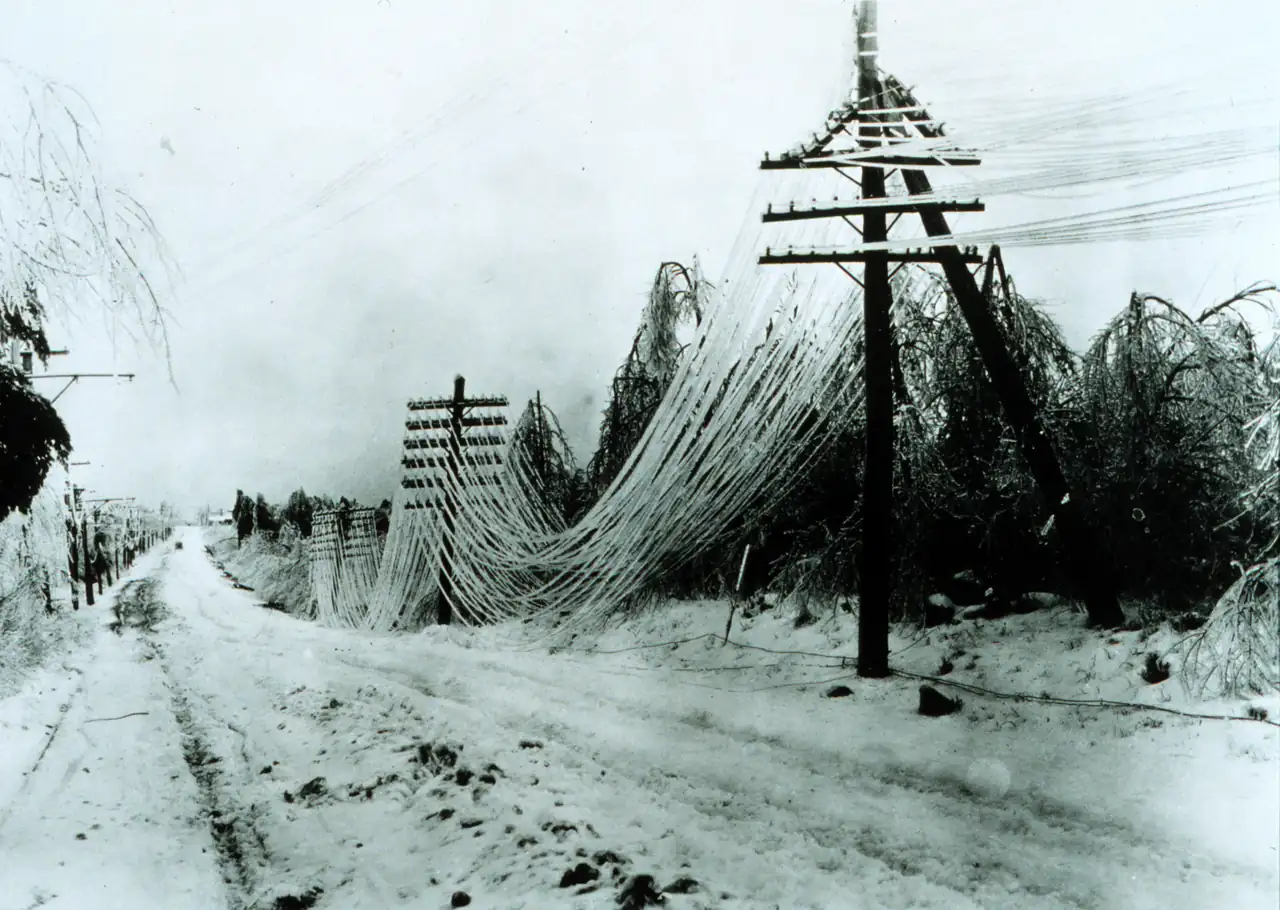
For a new house in the North Country, plan for backup power from the start. New Hampshire customers averaged about 736 minutes without power in 2024 once major storms are counted, against 84 minutes on ordinary days (EIA, Electric Power Annual Table 11.2). On a well, no power means no water and, with most heating systems, no heat. New Hampshire installers quote about $10,000 to $24,500 for a whole-house standby generator with an automatic transfer switch (A.J. LeBlanc; A. Pro Electric), and it costs less to plan the panel, pad and propane tank during design than to retrofit them.
How often does the power go out in New Hampshire?
The reliability numbers
Utilities report two outage figures to the federal government: one for ordinary days and one that includes “major event days,” the big storms. In New Hampshire the gap between them is huge, and it swings from year to year.
| Year | NH minutes without power, all events | NH minutes, excluding major events | Massachusetts, all events |
|---|---|---|---|
| 2024 | 735.5 (about 12.3 hours) | 84.2 | 103.7 |
| 2025 | 150.7 (about 2.5 hours) | 86.1 | 122.2 |
Source: EIA Electric Power Annual, Table 11.2, utilities using the IEEE method. These are statewide averages per customer. A house at the end of a long rural line with trees on both sides will do worse than the average.
On ordinary days New Hampshire’s 84 to 86 minutes is close to Massachusetts (77) and Connecticut (74) and well ahead of Maine and Vermont, per the same 2024 table. The storms are what hurt, and they come from heavy wet snow, ice and wind across a heavily forested state.
The storms that set the record
| Storm | What happened | Source |
|---|---|---|
| December 11 to 12, 2008 ice storm | More than 400,000 homes and businesses out statewide, about 55% of the state; 322,000 PSNH customers at peak. 99.9% restored after 13 days, on Christmas Eve; remote camps waited until December 31 | PSNH ice storm report, 2009 |
| December 18, 2023 rain and wind storm | More than 70,000 NH homes lost power; about 70 roads blocked | Granite Post |
| April 4, 2024 nor’easter | Heavy wet snow; about 170,000 customers out by afternoon, including roughly 43% of New Hampshire Electric Cooperative members. CBS Boston reported more than 230,000 at the peak | InDepthNH; CBS Boston |
Peak counts differ because sources tally the utilities’ maps at different hours. The PSNH report also quotes the Public Utilities Commission’s estimate that 75 to 80% of the trees that took down lines in 2008 were large trees outside the trimming zone. Tall trees along long rural lines are something no utility can fully fix.

What does a generator have to run in a North Country house?
The loads that matter in a power outage
Make the list before anyone talks about kilowatts. In a typical new house here it starts with:
- The well pump. Without power there is no water, so no toilets either.
- The heating system. A propane or oil boiler still needs power for its controls and circulator pumps, and a heat pump system is a much bigger electrical load.
- A septic pump, if the leach field sits above the house and the system has a pump chamber. Our site costs guide explains when that happens.
- The refrigerator and freezer, a sump pump, lights, outlets and internet.
Size for the well pump’s start
A submersible well pump draws a large surge for a fraction of a second as it starts, and a generator that can run the pump all day may still fail to start it. Franklin Electric, a major maker of submersible well motors, publishes the smallest generator for each of its motor sizes:
| Pump motor | Minimum generator, three-wire motor | Minimum generator, two-wire motor |
|---|---|---|
| 1/2 hp | 2 kW | 3 kW |
| 3/4 hp | 3 kW | 4.5 kW |
| 1 hp | 4 kW | 6 kW |
| 1.5 hp | 5 kW | 7.5 kW |
| 2 hp | 7.5 kW | not listed |
Source: Franklin Electric AIM Manual, 2026 edition (publisher page). These are for the pump alone; anything already running adds to the load. Franklin also warns that a generator running out of fuel with the pump on can damage the motor’s thrust bearing. Get the pump’s horsepower and wiring type from the driller’s paperwork or the control box label.
Whole house or essential circuits
A whole-house system runs everything through a service-rated transfer switch, so nobody has to think during an outage. An essential-circuit system feeds a smaller panel with the loads above, and costs less. Under the electrical code, an automatic system has to either carry every load it can switch on or use load management to shed some (Breaker Hunters summary of NEC 702.4). Load management lets a mid-size generator serve a house with big loads like an electric range or a heat pump: a controller drops those loads when the generator nears its limit.
If your main heat is a heat pump, decide early whether the generator will carry it or whether a wood stove or propane heater is your backup. Our heat pump and energy efficiency guide explains why we recommend a second heat source in this climate either way.
Propane, natural gas or diesel?
Natural gas is not an option in most of the North Country
The state’s utility list shows no natural gas utility serving Littleton, Lincoln, Lisbon or Bethlehem (NH Department of Energy). Liberty’s gas system runs up the Merrimack Valley to the Lakes Region and serves part of Berlin (NH PUC). For almost everyone reading this from Grafton County, the generator runs on propane.
Propane: how long a tank lasts
Generac’s spec sheet for its 22 kW air-cooled unit lists propane use of 2.53 gallons per hour at half load and 3.90 gallons at full load (Generac 16/20/22 kW spec sheet). Propane suppliers fill tanks to 80% so the liquid has room to expand, so a 500-gallon tank holds about 400 gallons (Ferrellgas).
| 500-gallon tank, full (400 gal) | Half load (2.53 gal/hr) | Full load (3.90 gal/hr) |
|---|---|---|
| Hours of run time | 400 ÷ 2.53 = 158 hours | 400 ÷ 3.90 = 103 hours |
| Days | about 6.6 | about 4.3 |
| Fuel cost per day at $4.26/gal | about $259 | about $399 |
Propane price: NH Department of Energy statewide average, November 2, 2026. If the same tank feeds your furnace, water heater and range, it will not last that long. A 250-gallon tank holds half as much.
The cold-weather catch: vaporization
A tank delivers gas by boiling liquid propane off the inside walls, and that slows down as the tank gets colder and emptier. Regulator maker RegO’s sizing method puts a 500-gallon tank that is 30% full at about 315,000 BTU per hour at 0°F, and half that at -10°F (RegO Field Topic, 2022). The Generac spec sheet says to multiply propane cubic feet per hour by 2,500 to get BTUs, so the 22 kW unit needs about 230,000 BTU per hour at half load (92 × 2,500) and 355,000 at full load (142 × 2,500).
Put those together: on a -10°F night, with the tank down to 30%, a single 500-gallon tank can supply about 157,500 BTU per hour, which is less than the generator needs even at half load. The engine runs lean and can shut down. Fixes are simple if you plan for them: keep the tank on automatic delivery and above half full in winter, go to a larger tank or two tanks, or ask the propane company to size for your design temperature. One New Hampshire Reddit commenter warned that some propane companies stop setting new tanks once winter arrives (r/newhampshire, November 2026), which is one more reason to settle this during construction.
Diesel: rarely the right call for a house
Diesel engines are durable, but stored diesel goes bad. Generac’s white paper gives today’s ultra-low-sulfur diesel a shelf life of six months to two years, with testing and “polishing” needed to keep it usable (Generac white paper). No. 2 diesel can also gel in the cold, while propane can sit in a tank nearly indefinitely (Consulting-Specifying Engineer). For a house that runs its generator a few dozen hours a year, propane wins.
Do you need a transfer switch or an interlock?
You need one or the other. The electrical code requires “transfer equipment” that prevents the generator and the utility from ever being connected at the same time (UL via IAEI Magazine, quoting NEC 702.5). Without it, a generator can push power back through your meter onto the street, where line crews expect dead wires.
A standby generator comes with an automatic transfer switch (ATS). It senses the outage, starts the generator and switches the house over within seconds, whether you are home or not.
A panel interlock kit is a sliding plate that makes it impossible to turn on the main breaker and the generator breaker together. UL treats listed interlock kits as transfer equipment when the panel is marked for that kit (same source). It is the low-cost way to run a portable generator through your panel, but someone has to be home to start it.
Never use a “double-male” cord plugged into a dryer outlet. That is how lineworkers get hurt.
On the same r/newhampshire thread, one owner reported paying about $2,200 five years ago for a portable generator plus an interlock and inlet installed by a licensed electrician (r/newhampshire). That works for a full-time resident but does nothing for a second home in January.
A portable generator also brings carbon monoxide risk. The U.S. Consumer Product Safety Commission says nearly 100 people a year die from carbon monoxide from portable generators, and tells owners to run them outside only, at least 20 feet from the house, never in a garage or on a porch (CPSC, February 2026).
What permits and licenses does New Hampshire require?
Electrical work
New Hampshire requires a licensed electrician for any electrical installation done for pay (RSA 319-C:1). The exception is a homeowner working on a single-family house they own and live in or will live in (RSA 319-C:15, II). Town forms add that a homeowner who pulls the permit must do the work personally (Town of Canterbury; City of Nashua). The exemption covers licensing only; the permit and inspection still apply.
Propane piping is fuel gas work, licensed separately through the state’s Mechanical Licensing Board (permits.llc summary of RSA 153). Usually the propane company sets the tank and runs the line, and the electrician does the switch and wiring.
Town permits
Littleton requires a building/zoning permit before excavation, new construction or enlargement of a structure (Town of Littleton). For a new house, the generator, pad and tank belong on the permit drawings and site plan from the start. For a retrofit, call the zoning office and ask what they need. Our building permits guide covers how each nearby town handles permits.
Where the generator can sit
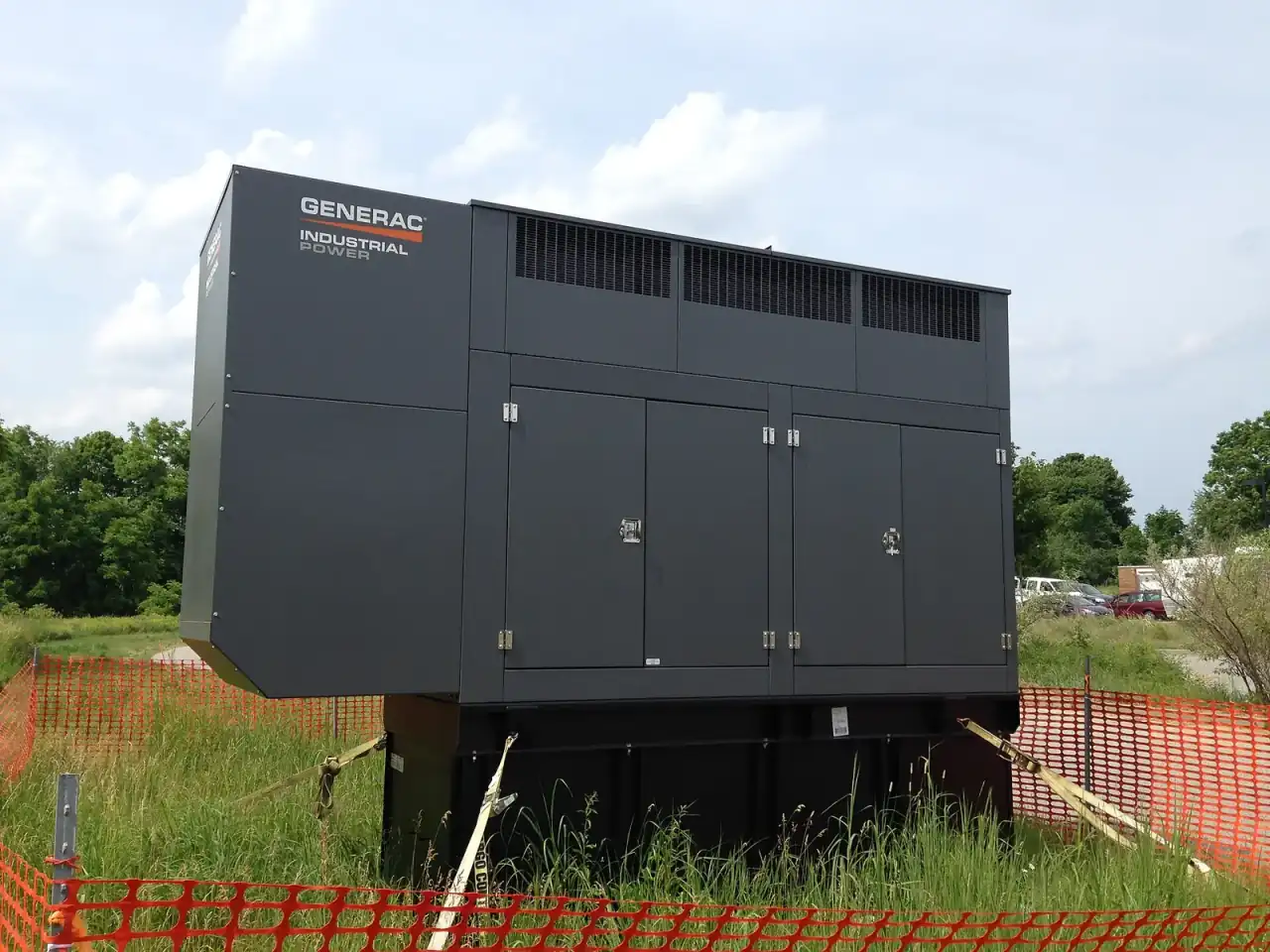
Generac’s installation guidelines, written to NFPA 37, call for 3 feet of clear space at the front and ends, 18 inches behind (only for units tested for the reduced clearance), 5 feet from any window, door, vent or other opening, and 5 feet of clear space above (Generac installation guidelines). Generac adds that a unit placed to code can still let carbon monoxide into a house, and may need to go farther away. Local codes can be stricter.
Up here, keep the unit out from under a dripline, since snow sliding off a steep metal roof can bury or damage it; our snow load guide covers where sliding snow lands. Set it above the drifts and out of the plow’s path, with a shoveled route to it and to the propane tank. Keep the runs short, too. Every foot between generator, panel and tank adds wire, pipe and trenching, and ledge makes trenching expensive.
How much does a standby generator cost in New Hampshire?
Published prices
| Source | What it covers | Price |
|---|---|---|
| A.J. LeBlanc, southern NH | Whole-home, all-in: generator, ATS, electrical and gas work, pad, permits | $10,000 to $24,500 |
| A. Pro Electric, NH | Whole system installed | $10,000 to $20,000 |
| Powers Guaranteed | Whole home / essential circuits | $15,000 to $18,000 / $13,000 to $15,000 |
| Tilton-area Generac dealer | Starting price, 22 kW with 200-amp switch, pad and battery, within 5 feet of the house | from $16,340 |
| Copp Electric, Lakes Region | Basic annual service plan | $350 a year |
Powers Guaranteed also lists the common add-ons: trenching $1,000 to $3,500, a panel upgrade $2,000 to $6,000, a utility service upgrade $2,000 to $3,000, and gas line work $2,000 to $4,000.
A worked example
A 22 kW propane unit for a new 2,500 sq ft house, 40 feet from the panel, with a new 500-gallon tank:
- Base installed price: $16,340 (Tilton dealer’s starting price)
- Trenching for wire and gas line: $1,000 to $3,500
- Gas line work: $2,000 to $4,000
- Total: about $19,300 to $23,800, plus the tank and the first fill, which your propane company prices (many lease the tank).
That lands near the top of the installer ranges above, which is where North Country jobs with longer runs tend to end up. On a new house, the panel and service are sized for the generator from the start, so the panel and service upgrade lines should not appear.
What owners report
On the November 2026 r/newhampshire thread, a self-described master electrician put typical installs at $7,000 to $12,000 or more. An Upper Valley owner said his 20 kW unit cost $7,000 installed in 2014, that service runs about $300 a year, and that in 12 years he has replaced the battery once and a lightning-damaged control board once (r/newhampshire). Those are individual reports, and 2014 prices are long gone.
Is a battery like a Powerwall a better choice?
What a battery can and can’t do
Tesla’s Powerwall 3 stores 13.5 kWh and delivers up to 11.5 kW continuously, and it can start motors rated up to 185 locked rotor amps (Tesla datasheet). That is enough to start many well pumps, but check the nameplate. Energy is the limit: at an average draw of 1 kW, which a well pump, boiler, refrigerator and a few lights can easily reach, 13.5 kWh lasts about 13 hours.
| Propane standby generator | One battery, no solar | Battery with solar | |
|---|---|---|---|
| Short outage (a few hours) | Covers it | Covers it, silently | Covers it |
| Three-day January outage | Covers it if the tank is sized | Runs out the first day | Little help if panels are snow-covered and days are short |
| Installed cost | about $10,000 to $24,500 | about $13,500 (EnergySage) | Battery plus the array |
| Upkeep | Annual service, fuel | Little | Little |
Incentives in 2026
The 30% federal credit that covered batteries and solar ended for expenditures after December 31, 2025 (IRS FS-2025-05). Eversource customers can get a rebate from the NH Clean Energy Fund of $230 per kWh of battery capacity, up to $3,000, plus 0% financing up to $10,000, in exchange for enrolling the battery in ConnectedSolutions (Eversource). ConnectedSolutions lets the utility draw on the battery on summer afternoons, June through September, and Eversource says it will not call events when a severe storm is forecast (Eversource ConnectedSolutions FAQ). The math for one Powerwall: 13.5 kWh × $230 = $3,105, capped at $3,000, so about $10,500 net. Around Littleton your power may come from Littleton Water & Light, Eversource or NHEC depending on the road (NH Department of Energy); if it isn’t Eversource, ask your utility what it offers.
Solar alone won’t keep the lights on
Grid-tied solar panels shut off when the grid goes down, by design, so they don’t energize lines crews are working on. To run during an outage, an array needs a battery and an inverter that can “island” the house (U.S. Department of Energy; NREL). New Hampshire’s net metering terms for Eversource customers are on the Eversource net metering page, and our energy guide covers how Littleton Water & Light’s rules differ.
Our take
A battery suits a full-time house with solar and a non-electric heat source, where most outages last hours. For a house on a well at the end of a long rural line, or a second home that sits empty in January, a propane standby generator is still what keeps water and heat on for days. Some owners do both.
How do you keep the house from freezing when you’re away?
A generator only helps if it starts, has fuel, and somebody knows when it doesn’t. For a second home or a long trip:
- Keep the heat at 55°F or higher and test the generator weekly, per Chubb’s guidance for unoccupied homes (Chubb). Standby units run a short automatic exercise; the 22 kW Generac’s is 5 minutes (spec sheet).
- Put internet-connected temperature sensors where pipes freeze as well as at the thermostat: sink cabinets on outside walls, near the well line, any plumbing in an unheated garage or crawl space. Put the modem and router on the generator circuit so alerts keep coming.
- Add a leak detector or automatic water shutoff valve and a caretaker who knows where the shutoffs are. If the house will be closed for the season, have a plumber shut off and drain the system instead (PURE Insurance).
- Put the propane tank on automatic delivery with a tank monitor, and make sure the plow contractor leaves the delivery truck a way in.
- Keep a non-electric heat source such as a wood stove if you can. It is the backup to the backup, which is why we recommend one in our guide to converting a camp to year-round use.
What should you settle during design?
The cheapest generator installs are the ones planned before the foundation is poured. Bring these to your design meetings:
- List the outage loads, with the well pump’s horsepower and wiring type.
- Choose whole-house with load management or an essential-circuit panel.
- Size the panel and service with room for the transfer switch.
- Site the generator for clearances, snow, the plow and short runs.
- Size the propane tank for run time and winter vaporization.
- Run conduit and gas line under the driveway before it’s paved.
- Decide whether a battery or solar is in the plan.
- Put the electrician, propane supplier and permit in the schedule.
If you are planning a new house in Littleton, Bethlehem, Franconia or nearby, we are glad to work through this list with you while the plans are still on paper. See our custom homes page or contact us to talk about your site.
Sources
- U.S. Energy Information Administration: Electric Power Annual, Table 11.2, Reliability Metrics Using IEEE Standard, by State, 2025 and 2024 (accessed November 2026)
- PSNH: Record Outage, Record Recovery, New Hampshire Ice Storm 2008 (February 2009) (accessed November 2026)
- Granite Post: New Hampshire faces road closures and power outages in wake of intense storm (December 18, 2023) (accessed November 2026)
- InDepthNH: About 104,000 Without Power Friday, Down from 170,000 (April 5, 2024) (accessed November 2026)
- CBS Boston: Winter storm leaves more than 230,000 New Hampshire customers without power (April 4, 2024) (accessed November 2026)
- NH Department of Energy: Utilities by City / Town (accessed November 2026)
- NH Public Utilities Commission: Gas (accessed November 2026)
- Franklin Electric: AIM Manual, 60 Hz Submersible Systems, 2026 edition (PDF copy) and Franklin AIM publisher page (accessed November 2026)
- Breaker Hunters: Generator Interlock Kits vs Transfer Switches (2025 Buyer’s Guide) (accessed November 2026)
- Generac: Guardian Series 16/20/22 kW Standby Generator Spec Sheet (accessed November 2026)
- Ferrellgas: Here’s why your propane tank is never full (accessed November 2026)
- NH Department of Energy: NH Fuel Prices (November 2, 2026) (accessed November 2026)
- RegO Products: Field Topic, Determining Propane Vapor Capacity (August 2022) (accessed November 2026)
- Reddit r/newhampshire: Home standby generator installer recommendations (November 2026) (accessed November 2026)
- Generac Industrial Power: Standby Power Generation Fuel Security, Diesel vs. Natural Gas (white paper) (accessed November 2026)
- Consulting-Specifying Engineer: How to make generator fuel type selection in four steps (May 2024) (accessed November 2026)
- IAEI Magazine, UL Question Corner: Panelboard interlock kits and NEC 702.5 (accessed November 2026)
- U.S. Consumer Product Safety Commission: Winter Storm May Knock Out Power; CPSC Warns of Deadly Carbon Monoxide and Fire Risks (February 19, 2026) (accessed November 2026)
- NH RSA 319-C:1, Electricians (accessed November 2026)
- NH RSA 319-C:15, Violations; Penalty; Homeowner’s Exception (accessed November 2026)
- Town of Canterbury, NH: Electrical Permit, Homeowner (accessed November 2026)
- City of Nashua, NH: Residential Electrical Application (accessed November 2026)
- permits.llc: Can You Do Your Own Wiring or Plumbing in New Hampshire? (October 2026) (accessed November 2026)
- Town of Littleton, NH: Regulations & Applications (accessed November 2026)
- Generac: Installation Guidelines, 60 Hz Air-Cooled Generators 10 kW to 26 kW (accessed November 2026)
- A.J. LeBlanc Heating: Generator Installation in Southern NH (accessed November 2026)
- A. Pro Electric: Standby Generators Explained (September 2026) (accessed November 2026)
- Powers Guaranteed Services: Standby Generator Installation Pricing (accessed November 2026)
- Lakes Region generator dealer, Tilton, NH: Generator models and starting installed prices (accessed November 2026)
- Copp Electric: What Does a Whole House Generator Cost in New Hampshire, Installed? (October 2026) (accessed November 2026)
- Tesla: Powerwall 3 Datasheet (accessed November 2026)
- EnergySage: Tesla Powerwall 3 Review (updated May 2026) (accessed November 2026)
- IRS: FAQs for modification of sections 25C, 25D and other energy credits under Public Law 119-21 (FS-2025-05) (accessed November 2026)
- Eversource: New Hampshire Battery Storage Incentives and Financing (accessed November 2026)
- Greater Grid: Eversource ConnectedSolutions Battery Program FAQ (accessed November 2026)
- U.S. Department of Energy: Solar and Resilience Basics (accessed November 2026)
- NREL: Will Solar Panels Help When the Power Goes Out? (2020) (accessed November 2026)
- Eversource: New Hampshire Net Metering (accessed November 2026)
- Chubb: Vacant but protected, tips for safeguarding vacant homes (August 2026) (accessed November 2026)
- PURE Insurance: How to Protect Your Seasonal or Secondary Home While You’re Away (November 2026) (accessed November 2026)